VPN Mexico for $2 a month
Your network knows exactly who you are and where. Atomic VPN swaps that for a Mexican IP in Mexico City.


Why people use a VPN in Mexico
One Mexican city in one app. Every feature on every plan.

Your accounts from abroad
Away from Mexico, your bank and government logins see a foreign location. Connect to Mexico City and you sign in the way you do at home.

Less for your ISP to see
Your provider sees one encrypted connection to our server. It doesn't see which sites you open after that.

Safer public Wi‑Fi
On networks you don't control, your traffic stays encrypted. If the connection drops, the kill switch stops traffic until the tunnel is back.

One city, zero detours
Mexico City sits on the network the same as every other location. No distance tax, no slower tier just because there's one city on the map.
What to know before you use a Mexico VPN
VPNs are legal in Mexico. There's no restriction on using one, and connecting to a server in Mexico City from anywhere else doesn't require any special permission.
Mexico has its own federal data protection law for private companies. It doesn't stop your ISP from seeing which sites you connect to. A VPN encrypts that connection before the ISP sees it.
What a VPN stops on public Wi-Fi in Mexico, and what it doesn't
Fake hotspots are a known trick wherever public Wi-Fi is busy, and airports and hotels are typical places. They're set up to look official and capture whatever passes through them unencrypted. A VPN encrypts your connection before it leaves your device, so a fake hotspot operator sees scrambled traffic instead of your login details.
What a VPN doesn't stop is phishing. A text message pretending to be from your bank, asking you to click a link and re-enter your password, works exactly the same whether or not you're connected to a VPN.
That scam targets you, not your connection.
We can't hand over what we never kept
What stands behind the network
What a Mexico VPN actually changes
Connect to a Mexican VPN server and the public IP visible to websites changes to the VPN server's IP. Traffic between your device and that server also travels through an encrypted tunnel, so your ISP or the network you're using has less visibility into where your traffic is going.
What doesn't change is your physical location. Apps and websites can still use GPS, Wi-Fi, account information, cookies or browser fingerprinting to recognize you or estimate where you are.
Pick a term. Everything else is the same






Frequently asked questions
Yes. VPNs are legal in Mexico and there's no registration needed to use one. What you do over the connection still has to be legal.
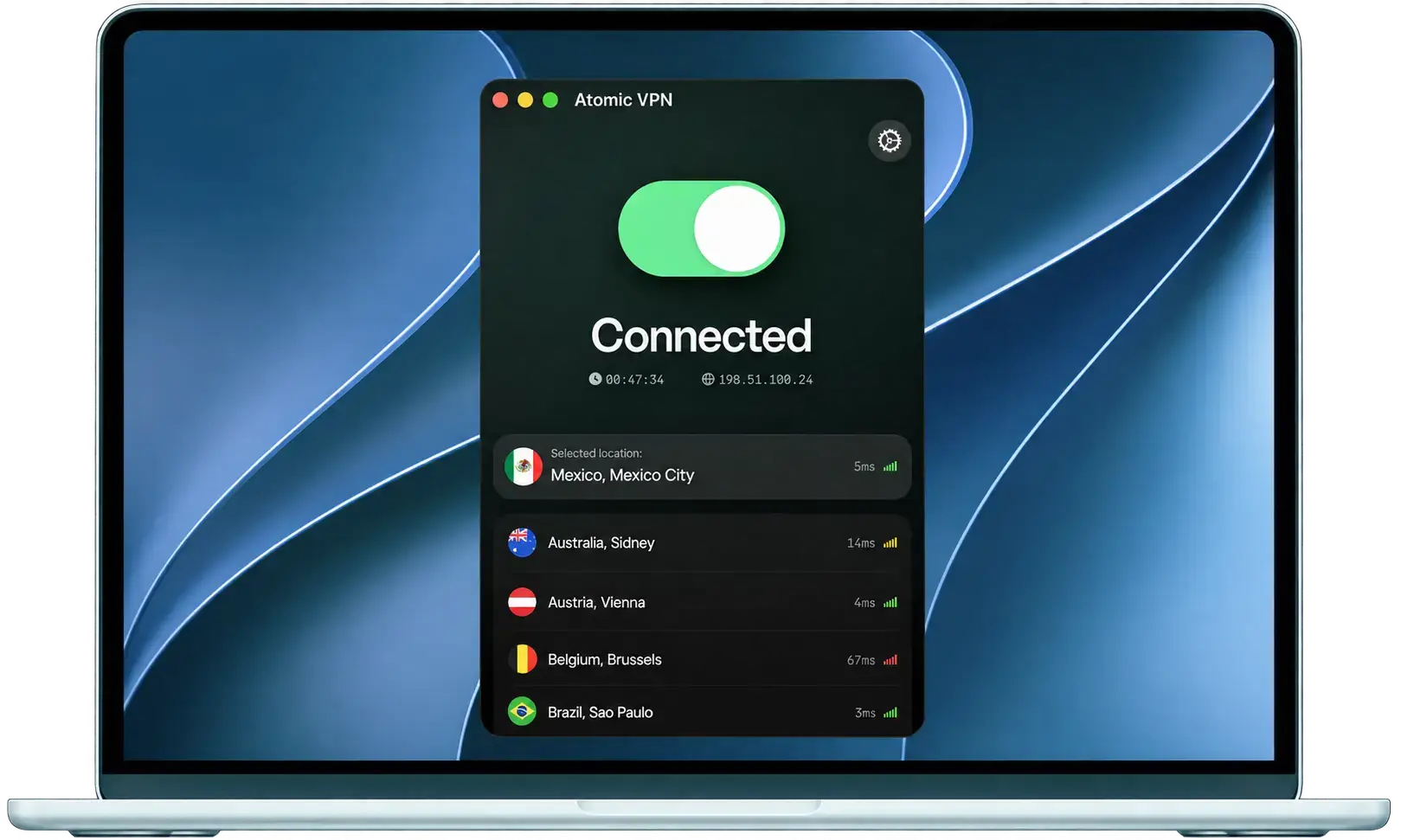
Install Atomic VPN on Windows, Mac or Android, choose Mexico in the location list and connect to the Mexico City server. An IP checker will then show a Mexican location. The iOS app is coming soon.
Windows, Mac and Android today, with iOS coming soon. Every feature, including the Mexico City location, is included on every plan.
Free VPNs still pay for servers somehow, often with ads or your data. Atomic VPN isn't free. It costs $2 a month on the yearly plan, billed $23.99 once a year, with every feature included.
Yes. Our Mexico VPN server is in Mexico City. P2P is allowed on it like every other server on the network.
Open the Atomic VPN app, search the location list for Mexico and connect to the Mexico City server. Your IP switches in a few seconds, no restart needed.
Get a Mexican IP for $2 a month
Mexico City, plus 88+ countries on the same account. $23.99 billed once a year. Cancel in one click.