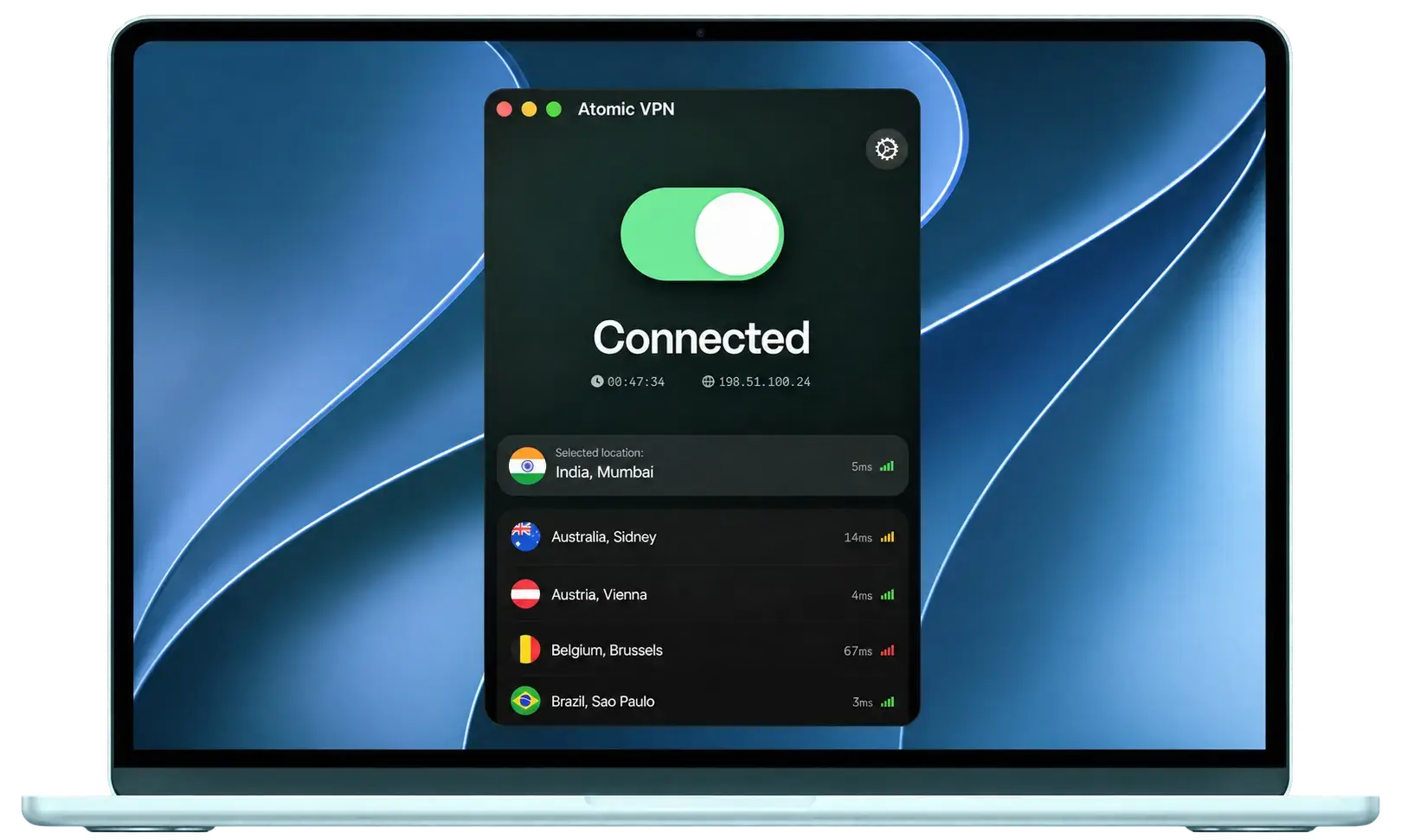
VPN India for $2 a month
Your network knows exactly who you are and where. Atomic VPN swaps that for an Indian IP in Mumbai.


Why people use a VPN in India
One Indian city in one app. Every feature on every plan.

Your accounts from abroad
Away from India, your bank and government logins see a foreign location. Connect to Mumbai and you sign in the way you do at home.

Less for your ISP to see
Your provider sees one encrypted connection to our server. It doesn't see which sites you open after that.

Safer public Wi‑Fi
On networks you don't control, your traffic stays encrypted. If the connection drops, the kill switch stops traffic until the tunnel is back.

One city, zero detours
Mumbai sits on the network the same as every other location. No distance tax, no slower tier just because there's one city on the map.
What to know before you use an India VPN
VPNs are legal in India for individuals. There's no law against using one, though government employees are restricted from using third-party VPNs for official work.
Your ISP can see every site you connect to unless the connection is encrypted first. A VPN encrypts that connection before it reaches the ISP, so all your provider sees is one connection to our Mumbai server.
Using an India VPN from abroad
Many Indian banking and government portals check where a login is coming from. A login from another country can trigger extra verification or get blocked. Indians living in the US, the UK or anywhere else can run into this.
Connecting to our Mumbai server puts your traffic back on an Indian IP before it reaches the portal. The login looks like a normal domestic one.
A VPN can't change everything. One-time passwords still go to your phone number, and apps can also check your SIM or account details.
We can't hand over what we never kept
What stands behind the network
What an India VPN actually changes
Connect to an Indian VPN server and the public IP visible to websites changes to the VPN server's IP. Traffic between your device and that server also travels through an encrypted tunnel, so your ISP or the network you're using has less visibility into where your traffic is going.
What doesn't change is your physical location. Apps and websites can still use GPS, Wi-Fi, account information, cookies or browser fingerprinting to recognize you or estimate where you are.
Pick a term. Everything else is the same






Frequently asked questions
Yes, for individuals. India's government restricts third-party VPN use for its employees at work, but there's no law against personal use. What you do over the connection still has to be legal.
Install Atomic VPN on Windows, Mac or Android, choose India in the location list and connect. An IP checker will then show a Mumbai-based Indian IP. The iOS app is coming soon.
Windows, Mac and Android today, with iOS coming soon. Every feature, including the India location, is included on every plan.
Free VPNs still pay for servers somehow, often with ads or your data. Atomic VPN isn't free. It costs $2 a month on the yearly plan, billed $23.99 once a year, with every feature included.
Yes. Our India VPN server is in Mumbai. P2P is allowed on it like every other server on the network.
Yes. Open the Atomic VPN app anywhere in the world, including the US, and connect to the Mumbai server. Your traffic routes through an Indian IP the same way it would from inside the country.
Get an Indian IP for $2 a month
Mumbai, plus 88+ countries on the same account. $23.99 billed once a year. Cancel in one click.