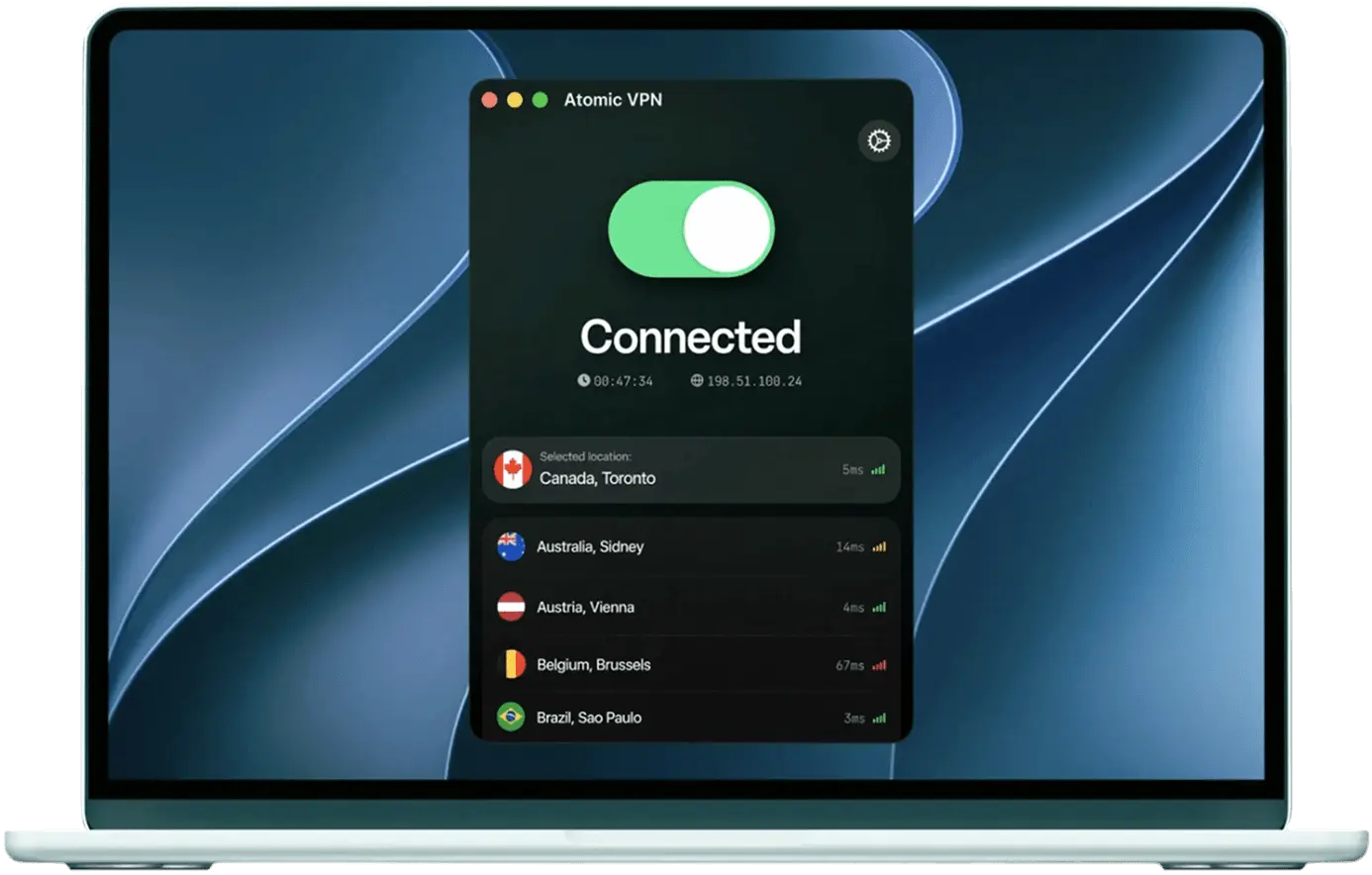
VPN Canada for $2 a month
Your network knows exactly who you are and where. Atomic VPN swaps that for a Canadian IP in Toronto, Montreal or Vancouver.


Why people use a VPN in Canada
Three Canadian cities in one app. Every feature on every plan.

Your accounts from abroad
Out of the country, your Canadian bank and government accounts see a foreign login. Connect to Canada and you sign in from a Canadian IP like you do at home.

Less for your ISP to see
Your provider sees one encrypted connection to our server. It doesn't see which sites you open after that.

Safer public Wi‑Fi
On networks you don't control, your traffic stays encrypted. If the connection drops, the kill switch stops traffic until the tunnel is back.

Three cities to pick from
Toronto, Montreal and Vancouver. Pick the one closest to you for the lowest delay.
What to know before you use a Canada VPN
VPNs are legal in Canada and the internet there is lightly censored compared with most countries. Canada is also part of Five Eyes, the intelligence-sharing group with the US, UK, Australia and New Zealand. That's a good reason to check where a VPN keeps data. Atomic VPN servers run from RAM and keep no connection logs.
Your ISP falls under PIPEDA, the federal privacy law for private companies. The law limits what your ISP does with your data. It doesn't stop the ISP from seeing which sites you connect to. A VPN is what changes that part.
Why server location in Canada matters
Canadian traffic sometimes leaves the country before it arrives, even when both ends are in Canada. Researchers at the University of Toronto's IXmaps project call this boomerang routing. A message sent from Toronto to a server in Montreal can pass through New York or Chicago on the way. Research by CIRA and Packet Clearing House found the same pattern in domestic routes.
Part of the reason is infrastructure. Canada has far fewer internet exchange points than the US, the places where networks hand traffic to each other. When there's no exchange nearby, carriers often hand it off at the nearest big hub, and for much of Canada that hub sits south of the border.
This doesn't depend on whether you use a VPN. A Canadian VPN server can see the same US detour on its way to you. What a VPN adds is encryption for that leg, not a different set of wires.
We can't hand over what we never kept
What stands behind the network
What a Canada VPN actually changes
Connect to a Canadian VPN server and the public IP visible to websites changes to the VPN server’s IP. Traffic between your device and that server also travels through an encrypted tunnel, so your ISP or the network you’re using has less visibility into where your traffic is going.
What doesn’t change is your physical location. Apps and websites can still use GPS, Wi-Fi, account information, cookies or browser fingerprinting to recognize you or estimate where you are.
Pick a term. Everything else is the same






Frequently asked questions
Yes. Using a VPN is legal in Canada. Picking a Canadian server from abroad is fine too. What you do over the connection still has to be legal.
Install Atomic VPN on Windows, Mac or Android. Choose Canada in the location list, pick Toronto, Montreal or Vancouver and connect. An IP checker will then show a Canadian location. The iOS app is coming soon.
The one closest to you. Distance adds delay. Vancouver suits BC and the US West Coast. Toronto suits Ontario and the US East Coast. Montreal suits Quebec.
Free VPNs still pay for servers somehow. Often it's with ads or your data. Atomic VPN isn't free. It costs $2 a month on the yearly plan, billed $23.99 once a year. Every feature is included.
Yes. Atomic VPN runs servers in Toronto, Montreal and Vancouver. P2P is allowed on all three, with no throttling. Pick whichever is closest and connect in one click.
Open the Atomic VPN app and search the location list for Canada. Pick Toronto, Montreal or Vancouver and hit connect. Your IP switches in a few seconds, with no restart or extra settings needed.
Get a Canadian IP for $2 a month
Toronto, Montreal and Vancouver, plus 88+ countries on the same account. $23.99 billed once a year. Cancel in one click.