The same game or digital subscription can cost different amounts depending on the country where it is sold. Regional pricing exists across gaming stores and subscription services because companies adjust prices around local currencies, taxes and market conditions. That makes changing your apparent location with a VPN sound like an easy way to pay less.
In practice, the IP address is only one part of the purchase. Major stores increasingly connect pricing to an account country, billing address or local payment method, which means switching to a cheaper VPN location may change what you see without changing what you are actually allowed to buy. Some platforms go further and explicitly prohibit using location-masking tools to obtain prices intended for another region.
A VPN can still be useful for comparing regional storefronts and understanding how prices vary, especially when you travel or move between countries. The important part is knowing when the store uses your IP address and when it relies on account and payment information instead.
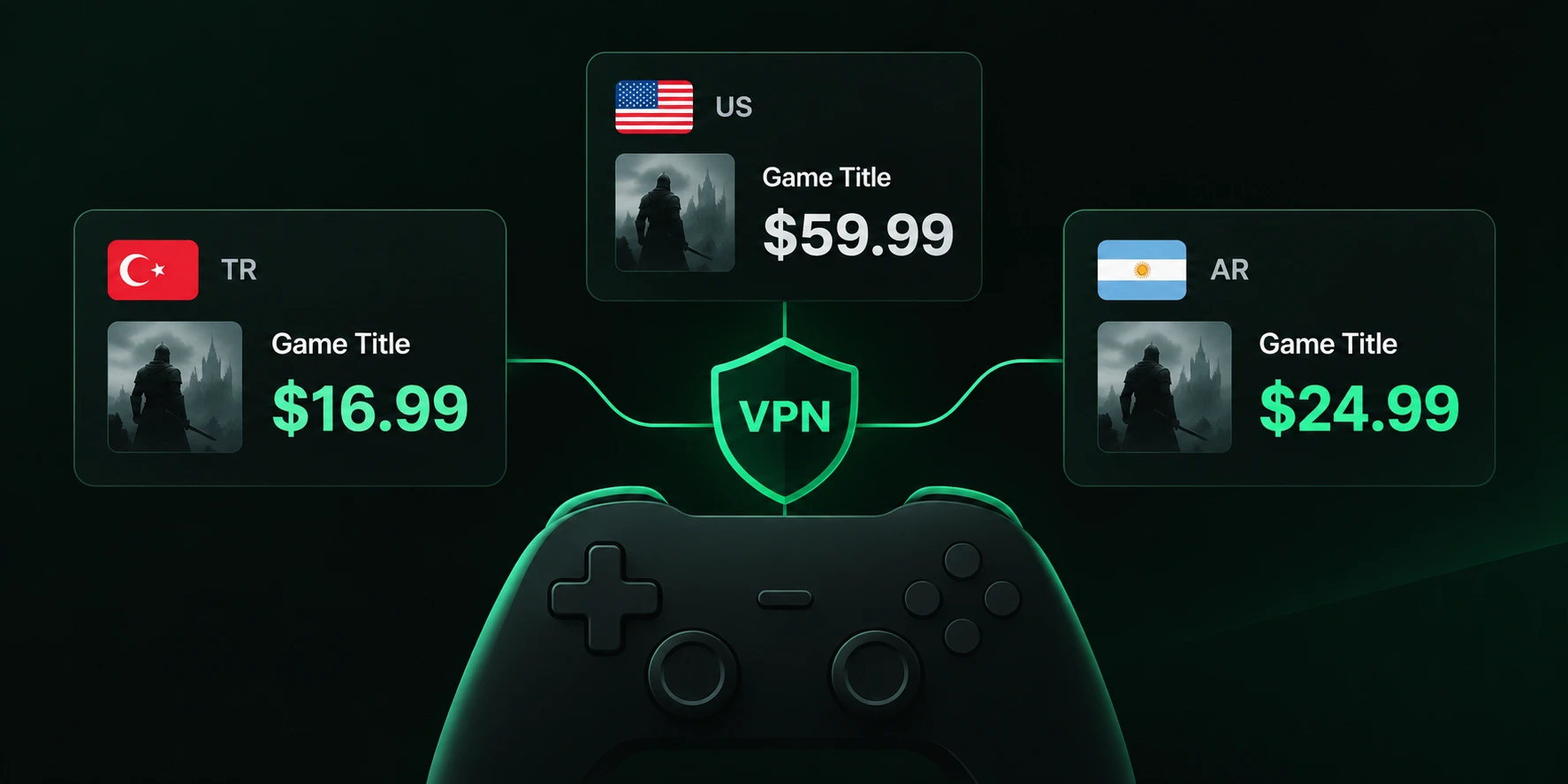
Why games and subscriptions have different prices by country
Digital products do not have to carry one worldwide price. Publishers and subscription companies can set different prices for different markets, while taxes and exchange rates can widen the gap further.
That is why a $60 game in one market does not necessarily convert directly into the same local-currency price everywhere else. Subscription services can follow the same model, particularly when a company has separate pricing pages or billing systems for different countries.
A website may use your IP address to determine which regional storefront to show, but that does not mean the IP address controls the entire checkout process. Once you sign in, the service may already know your store country from your account, and the payment provider may verify whether your card belongs to the same region.
Can you actually use a VPN to buy things cheaper?
Sometimes a VPN can reveal a different regional price, but seeing that price and successfully buying at that price are two separate things. On a simple website that localizes its storefront mainly from the visitor's IP address, changing VPN servers may be enough to show a different currency or offer.
Large gaming stores usually have more checks. They can associate purchases with the country on your account, require a local payment method or restrict how frequently the account region can be changed. In those cases, connecting to a server in a cheaper country does not automatically make you eligible for that country's prices.
The store's rules matter as much as the technical setup. If a platform requires your store country to represent where you actually live, using a VPN to pretend that you reside somewhere else can violate its terms even if the checkout initially appears to work.
This distinction is especially important for the keyword people often search directly, "using VPN to buy things cheaper." A VPN can change what a website detects about your network location, but it cannot change your billing country, account history or the terms attached to the purchase.
Can you use a VPN to buy Steam games cheaper?
Steam is the clearest example of why a VPN alone is not a reliable regional-pricing trick. According to Steam's official Store Country rules, your store country is associated with where you reside and the payment method used for purchases. If you genuinely move to another country, Steam allows you to update the store country when making a purchase with a payment method from that new location.
Travel works differently. Steam says that when you are visiting another country, the store continues to show prices for your existing store country, so simply connecting from abroad does not normally convert an established account into the local store. Steam also limits store-country changes to once every three months.
More importantly, the Steam Subscriber Agreement explicitly prohibits disguising your place of residence with IP proxying or similar methods to obtain pricing that does not apply to your geography. Valve states that doing so can result in termination of access to the account.
Steam's purchase support also says that transactions initiated through anonymous proxies may be declined and advises users experiencing purchase problems to disable VPN or proxy software. That makes Steam a poor candidate for the common "connect to the cheapest country and buy" method, even before considering the account risk.
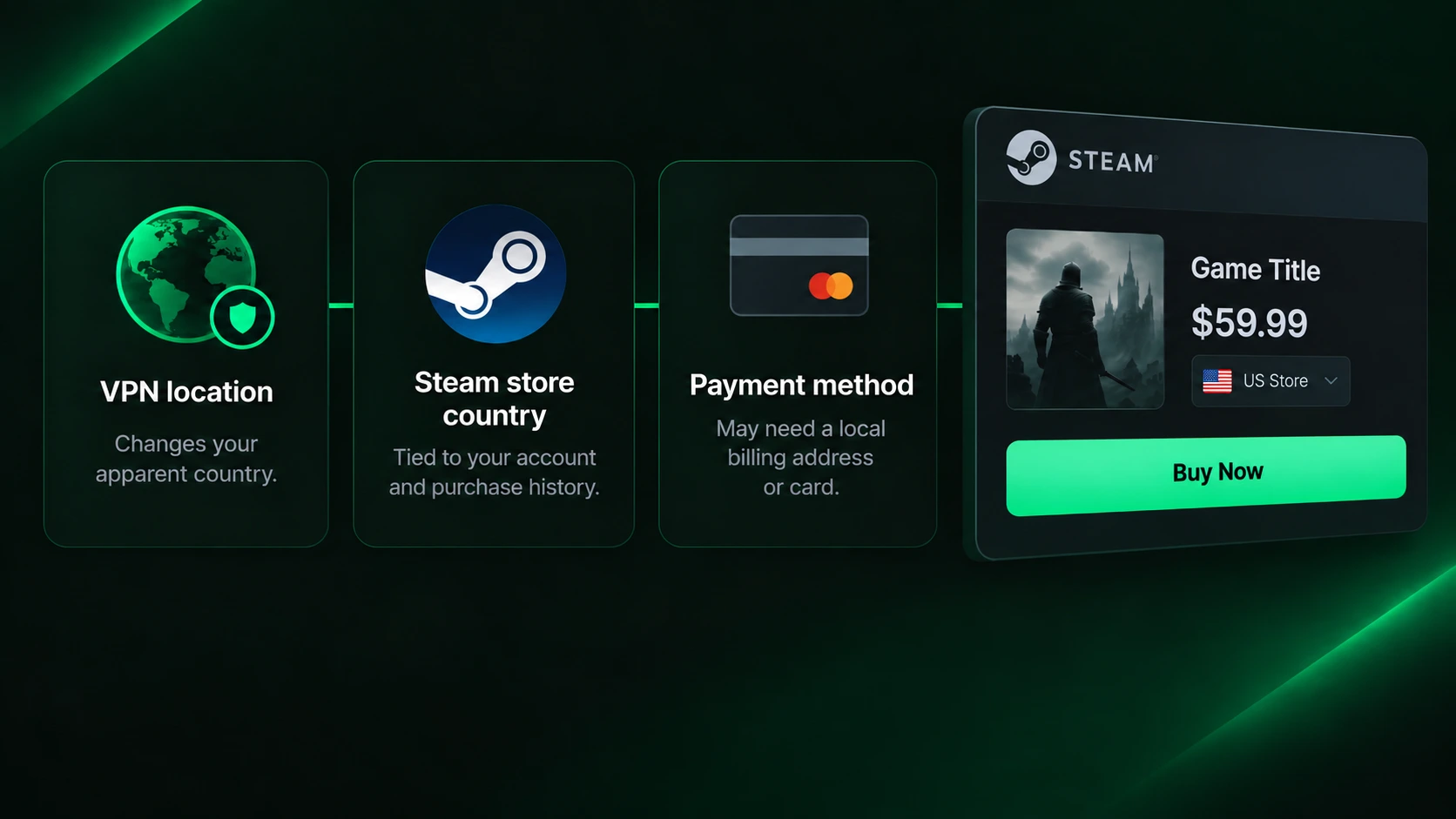
Why changing your Steam IP is not enough
The important variable on Steam is the store country rather than the IP address alone. A VPN can make the connection appear to originate somewhere else, but Steam still has account information and payment details that can point to the user's actual store region.
This is also why buying a foreign Steam Wallet code is not a simple workaround. Steam states that wallet codes and game keys cannot be used to change the store-country setting, so changing the funding method does not automatically move the account into another pricing region.
If you have genuinely moved, there is a legitimate route to regional pricing because Steam allows the store country to be updated when the account holder is in the new location and has a payment method associated with it. The distinction is between reflecting a real move and presenting a different location solely to access another region's prices.
What about Xbox games and Game Pass?
Microsoft also uses account and billing information when handling regional purchases. Its official guidance for changing Microsoft Store regions recommends changing the country or region only when moving somewhere else for an extended period, because games, subscriptions and account balances can behave differently between regions.
When a user makes the first purchase after moving to a new region, Microsoft can ask for updated billing information. Existing Microsoft account funds also do not transfer between regions, which makes the process more involved than connecting to a foreign VPN server.
The same regional system covers Xbox products and services, including subscriptions associated with the Microsoft account. A VPN can affect the network location seen by a storefront, but it does not replace the account-region and billing requirements that Microsoft uses for purchases.
Can a VPN get cheaper PlayStation games or PS Plus?
PlayStation is even less flexible because the country or region attached to a PlayStation account cannot currently be changed after the account is created. Sony tells users to select their real country or region when registering and says that the region should match their billing information for purchases to work correctly.
Regional PlayStation Stores can have different content and pricing, but the existing account remains tied to its original country. This means connecting to a VPN server elsewhere does not convert the account into a PlayStation account from that region.
Sony's current terms also require account information to be accurate and complete, while the selected account country is supposed to represent the user's country or region of residence. For an established PlayStation account, a VPN therefore has limited influence over which regional store the account actually belongs to.
What about Nintendo eShop?
Nintendo handles regions differently again. The Nintendo eShop follows the country setting on the Nintendo Account, and Nintendo allows that account country to be changed under certain conditions.
There are practical restrictions around that change. An existing eShop balance may need to be spent first, while active auto-renewals or pre-orders can prevent the region from being changed until they are resolved. Nintendo also notes that cards issued in one region may not work in another region's eShop.
A VPN is therefore not the main mechanism controlling Nintendo pricing either. The account region determines which eShop opens, while payment compatibility can determine whether the purchase can actually be completed.
Can you use a VPN to get cheaper subscriptions?
Subscriptions can also have regional pricing, which creates the same temptation to connect to a low-cost country before signing up. The problem is that modern subscription systems increasingly verify the subscription country through several signals rather than relying entirely on an IP address.
YouTube Premium provides a particularly clear example. Google's current YouTube Premium travel and location policysays a subscription should be used predominantly in the country where it was purchased and requires users to represent their country accurately when signing up. Google specifically warns that misrepresenting the location with a VPN or circumventing regional availability can lead to cancellation of the subscription.
Payment can introduce another check. Google's YouTube Premium payment guidance states that some countries require a payment method issued in that country, so a cheaper local subscription price does not necessarily become purchasable simply because a VPN reports a local IP address.
Other subscription platforms can use their own combinations of billing country, account region and location signals. The details vary, but the general lesson is consistent. Before trying to purchase through another region, check how that specific service defines the subscription country and whether it permits regional changes.
Why a VPN can change the displayed price without changing the checkout price
Many discussions about cheaper purchases stop as soon as a website displays another number. That can make a VPN look more effective than it really is because the final checkout may perform additional checks that the public product page does not.
A storefront can initially localize the page from an IP address and then switch back to account pricing after login. It can also reject the payment if the card country does not match the selected region, or apply taxes based on billing information rather than the apparent network location.
This means screenshots of different regional prices prove that regional pricing exists, but they do not prove that a user from another country can legitimately purchase at each of those prices. For a useful comparison, both the displayed price and the actual eligibility rules need to be considered.
Which platforms are most dependent on account region?
The major gaming stores take noticeably different approaches, which makes a single "VPN trick" difficult to generalize across them.
Steam ties the store country to residence and local payment information, while explicitly prohibiting location disguise for regional pricing. PlayStation locks the account region after creation, whereas Nintendo allows country changes but attaches payment and account restrictions. Microsoft allows region changes and recommends them primarily when a user has actually moved.
The common pattern is that the account carries more weight than a temporary IP address. A VPN may influence what an unsigned visitor sees, but established digital stores have other ways to determine where a purchase belongs.
Can a VPN still help you compare prices?
Yes, price comparison is one area where changing server locations can still be useful. Some websites show region-specific pages or currencies before the user signs in, so switching locations can help reveal whether the same service is priced differently elsewhere.
That information is useful when moving to another country or evaluating the true cost of a service across markets. It can also help distinguish an actual regional-price difference from a simple currency conversion.
If you are testing public prices this way, use the result as research rather than assuming it creates eligibility for the cheaper offer. The purchase rules of the store still determine whether the regional price applies to you.
Atomic VPN provides servers across more than 88 countries, which makes it possible to compare how public websites respond to different network locations without repeatedly changing physical networks. The service also states in its Terms of Use that users are responsible for using the VPN lawfully and complying with applicable third-party agreements.
What can go wrong when buying from another region?
The first problem is often much simpler than an account ban. The payment can fail because the store detects a mismatch between the account country and the card, which can leave the user repeatedly changing settings without ever reaching a valid checkout.
Regional purchases can also create problems later. Store credit may remain locked to one region, add-ons can require matching regional versions and subscriptions may behave differently after the account location changes. Microsoft, Nintendo and PlayStation all document some form of regional limitation around purchases or account content.
There is also a terms-of-service risk where the platform explicitly requires truthful residence information. Steam is unusually direct about this and states that using IP masking to purchase at prices unavailable to your geography can lead to account termination.
What if you actually move to another country?
Moving is different from pretending to be somewhere else. Several platforms provide official procedures for users whose real country of residence has changed, although those procedures vary substantially.
Steam lets eligible users update their store country when completing a purchase with a payment method from the new country, while Microsoft allows the account and Store region to be updated and recommends doing so when relocating for an extended period.
Nintendo also allows a Nintendo Account country to be changed after certain outstanding balances or subscriptions are dealt with. PlayStation is the main exception among the stores discussed here because Sony currently says the account's country or region cannot be changed after creation.
A VPN can still be useful during a move for normal privacy and connection security, but it should not replace the store's official account-migration process.
How to check whether a cheaper regional price applies to you
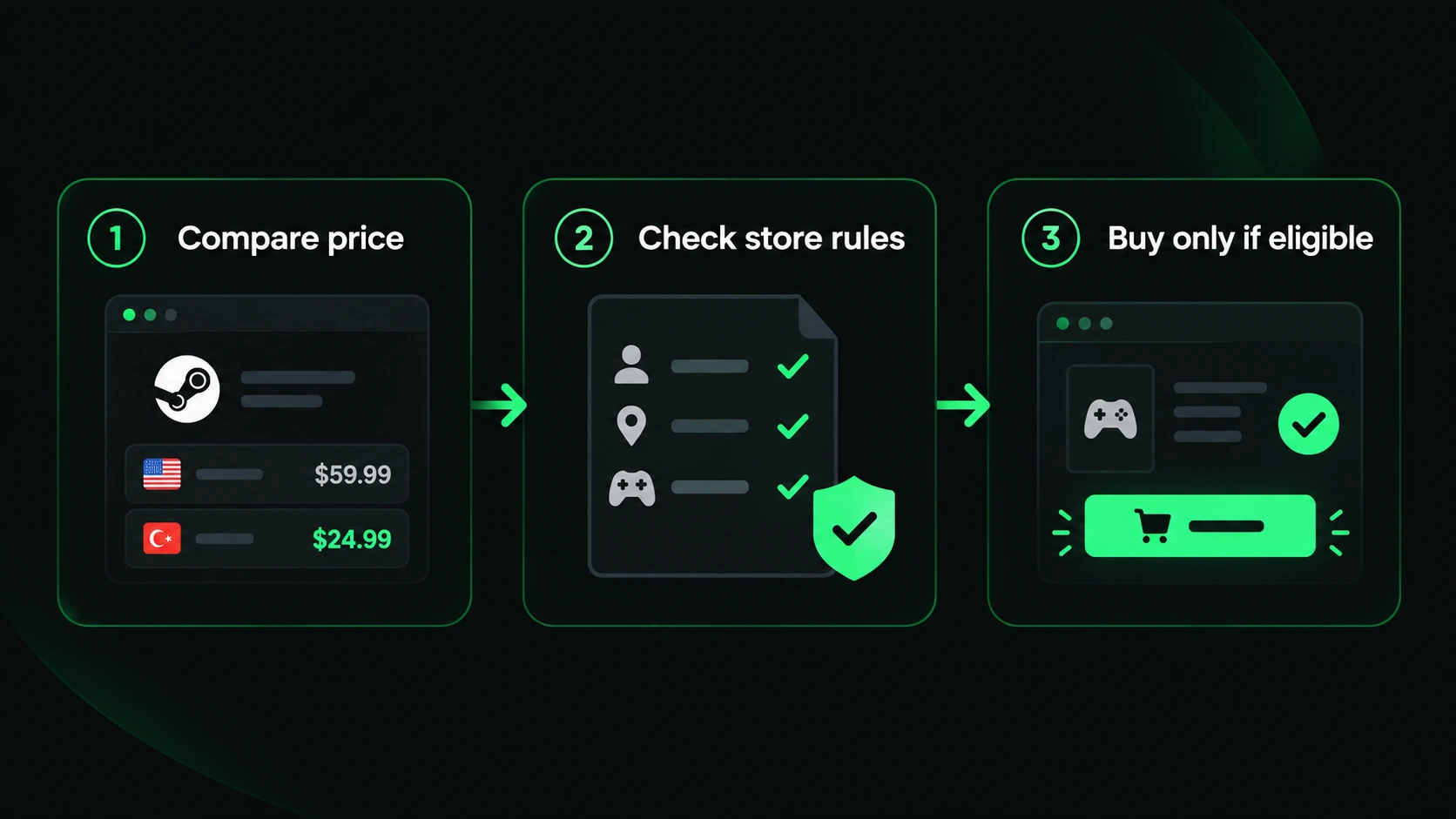
Start by comparing the public storefront before changing anything on your account. A VPN server in another country may show whether the site uses IP-based localization and whether a meaningful price difference exists.
Before buying, check the service's own region policy and the country associated with your account. If the store requires a local billing method or proof of residence, that requirement matters more than the IP address shown to the website.
When you have genuinely moved, follow the official account-region process rather than trying to force a different storefront through network location alone. This keeps purchases, refunds and future subscriptions connected to the region where you actually live.
Is using a VPN to buy games cheaper legal?
There is no universal law making it illegal to view a foreign game storefront through a VPN. The more immediate issue for most users is the agreement they have with the store and whether the purchase involves inaccurate account or residence information.
Platform terms can be stricter than the underlying law. Steam, for example, explicitly prohibits disguising residence to access different regional prices, while other stores rely on account-country or billing rules that make the same technique ineffective.
Local consumer, tax and digital-content laws can also differ between countries. If a purchase depends on falsely representing where you live, the safest approach is to avoid assuming that a successful checkout means the transaction complied with every applicable rule.
So, can a VPN really get you cheaper games and subscriptions?
A VPN can show you how a website looks from another country and can sometimes reveal a cheaper regional price. That makes it useful for comparing prices, especially when a website localizes its public storefront from the visitor's IP address.
For major gaming stores and subscriptions, the VPN is rarely the only factor that matters. Steam checks store country and local payment information, PlayStation accounts are tied to a fixed region, and services such as YouTube Premium explicitly require users to represent their subscription country accurately.
The practical answer is therefore less exciting than many "cheap VPN shopping" tricks suggest. Use a VPN to research regional pricing and to protect your connection, but check the account and payment rules before assuming a lower foreign price is available to you.
If you want to compare public storefronts across different locations, Atomic VPN offers servers in more than 88 countriesand supports modern VPN protocols across its network. According to the Atomic VPN Privacy Policy, browsing history, DNS queries and the destinations reached through the VPN are not stored as network activity logs.
.webp)
.png)