The short answer to "how much does a VPN cost" is about $9 to $15 a month for most well-known VPNs if you pay monthly. On a yearly or two-year plan, it drops to about $2 to $6 a month. That puts the first year at roughly $24 to $75. The bigger number comes later, because many plans renew at a much higher price. Below you'll find typical prices, what you'll really pay over three years and the costs that don't show up in the headline price.
How much does a VPN cost per month?
The monthly price depends mostly on how long you commit. Short plans cost the most per month. Long plans cost the least. In return, you pay for the whole term upfront.
A monthly plan from a well-known provider usually costs $9 to $15, with a few cheaper exceptions. For example, Windscribe charges $9 a month. NordVPN and ExpressVPN both charge $14.99. Yearly plans drop to about $2 to $6 a month. Two-year plans often go lower still. NordVPN and Proton VPN both show $3.49 a month on their two-year plans.
So when people ask how much is a VPN per month, the answer depends on the plan. The "VPN cost per month" you see in ads is almost never what you pay each month. It's the total for one or two years divided by 12 or 24.
How much does a VPN cost per year, including renewals?
The first-year price is only half the story. Many providers give a big discount on the first term and then renew at a higher rate. That's why the yearly VPN cost can more than double from year one to year two.
The table below shows what you'd pay if you bought each provider's yearly plan and kept it for three years. Year 1 is the discounted price you see in ads. Years 2 and 3 are what the plan renews at.
The jump after year one is the part people miss. NordVPN's yearly plan, for example, costs $65.88 at first and then renews at $139.08 a year, more than double. Proton VPN renews at $83.88 after a $53.88 first year. ExpressVPN renews at $99.95 after its first 15 months.
Even with renewals, a yearly plan still beats paying month to month. NordVPN and ExpressVPN both charge $14.99 on their monthly plans. Over three years, that adds up to $539.64.
Hidden VPN costs to check before you pay
Most extra costs hide in the small print rather than in the price itself. Here's what to look for on the checkout page.
Renewal price
First, find the line that says what the plan renews at. If it isn't on the pricing page, it's usually in the checkout summary or the terms. Set a reminder a week before renewal if you plan to switch.
Basic tiers and add-ons
Several big brands now sell a basic plan and charge more for higher tiers with extras such as a password manager or antivirus. The headline price almost always refers to the basic plan. Check what it includes before you compare prices.
Taxes at checkout
Also, prices on VPN sites usually don't include tax. NordVPN notes that "sales tax may apply," and ExpressVPN adds sales tax at checkout where applicable. Depending on where you live, the final price can end up a few dollars higher.
Refund terms
Most paid VPNs offer a money-back period. NordVPN and Proton VPN, for example, both give 30 days. Each provider sets its own conditions. Read them before you count on a refund.
Why does a VPN cost money?
A VPN costs money because running one is expensive. The provider rents or owns servers in dozens of countries and pays for the bandwidth all its users push through them. It also builds and updates apps for every platform and runs support. The better providers also pay for independent audits of their no-log policy.
Free VPNs, however, have the same costs. They cover them in other ways, such as tight data caps, slow servers and ads. The worst ones collect and sell user data. A free plan from a trusted provider can work for light use. For daily use, our guide on whether a VPN is worth it goes through the trade-offs.
VPN cost per device and per household
Most VPN plans cover several devices at once, which changes the real price. To compare fairly, divide the yearly cost by the number of devices you'll actually use.
For example, a $60 yearly plan that covers 10 devices costs $6 per device per year. That only holds if you really use all 10. For a family of three with a phone and a laptop each, one plan with enough device slots costs far less than three separate subscriptions. However, device limits vary a lot. Some big providers allow 10 devices. A few have no limit at all. For a household, a VPN on the router can protect every device at home, including smart TVs and consoles that can't run VPN apps. Our streaming guide explains how to set up a VPN on your TV.
How to pay less for a VPN
The cheapest VPN over time isn't always the one with the lowest headline price. These habits keep the total down.
- Pick a term you'll actually use. A two-year plan only saves money if you keep the VPN for two years.
- Use the money-back window to test a VPN before you commit to a long plan.
- Skip bundles you won't use. If you already have a password manager or antivirus, the basic tier is enough.
- Count your devices. If one plan covers the whole household, you don't need two subscriptions.
- Turn off auto-renew if you plan to switch, then turn it back on if you stay.
Finally, be careful with lifetime deals. A VPN has to keep paying for servers and bandwidth every month. A one-time payment only works if the provider stays in business and keeps the servers running. Once it doesn't, the lifetime plan is worth nothing.
How much does a VPN cost for a company?
Business VPNs, by contrast, are priced per user, not per household. They also come with admin tools, shared gateways and user management that personal plans don't have.
A business VPN service usually charges per user per month. NordLayer, for example, starts at $8 per user per month on yearly billing, with a minimum of five users. That's $480 a year for a team of five. Higher tiers cost more. Some of them also need a dedicated server at extra cost.
Meanwhile, some companies run their own VPN in the cloud instead. AWS Client VPN charges for every hour the VPN endpoint is set up and for every hour each person is connected. In AWS's US East (Ohio) example, that's $0.10 an hour per endpoint and $0.05 an hour per connection. For 10 people who connect 8 hours a day for 22 workdays, that comes to about $161 a month before data transfer and setup time.
For a freelancer or a very small team, a personal VPN plan is often enough. Once you need shared access to company systems, a business product makes more sense.
What Atomic VPN costs and how the price stays the same
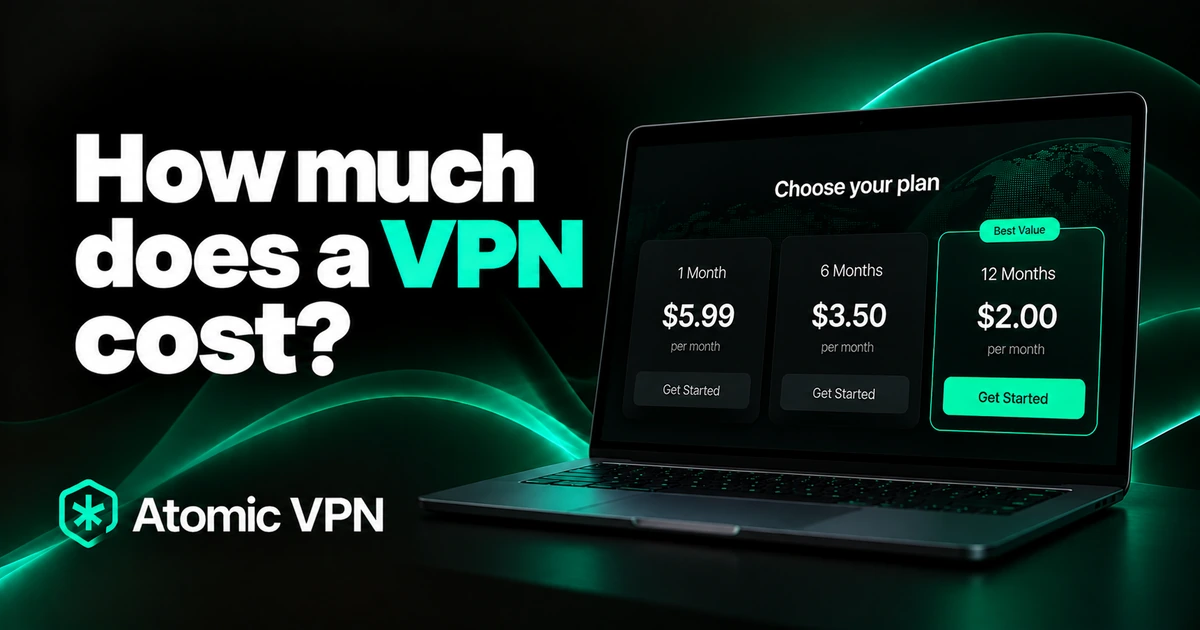
Atomic VPN is $5.99 month to month, $3.50 a month on the 6-month plan (billed $21) or $2 a month on the yearly plan, billed $24 once a year. The yearly plan renews at the same $24, with no intro price that goes up later.
Every plan has the same features, including the kill switch, split tunneling and unlimited data. Over three years, the yearly plan costs $72 in total. One plan covers 5 devices at once, which works out to $4.80 per device per year. A router setup protects the rest of your home without using a slot. You can pay by card or crypto and cancel in one click.
If you want to compare providers side by side, our ranking of the cheapest VPN services lists current prices for the big names.
Start with the plan length you'll really use, then check the three-year total before you pay.