
VPNs are legal in most countries and are widely used for everyday purposes such as securing a connection on public Wi-Fi or accessing a company network remotely. The technology itself is a standard part of modern network security, although the rules surrounding consumer VPN services vary depending on where you are.
Most of the confusion comes from treating every restriction as a VPN ban. A country can allow people to use VPN technology while blocking individual providers, regulating companies that offer VPN services or limiting access to particular online content. Some governments go further and restrict unauthorized methods of bypassing national internet filtering.
This means the answer to whether VPNs are legal depends on both location and use. A VPN changes how traffic reaches the internet and which IP address websites see, but it does not change the laws that apply to the activity itself.
Are VPNs legal?
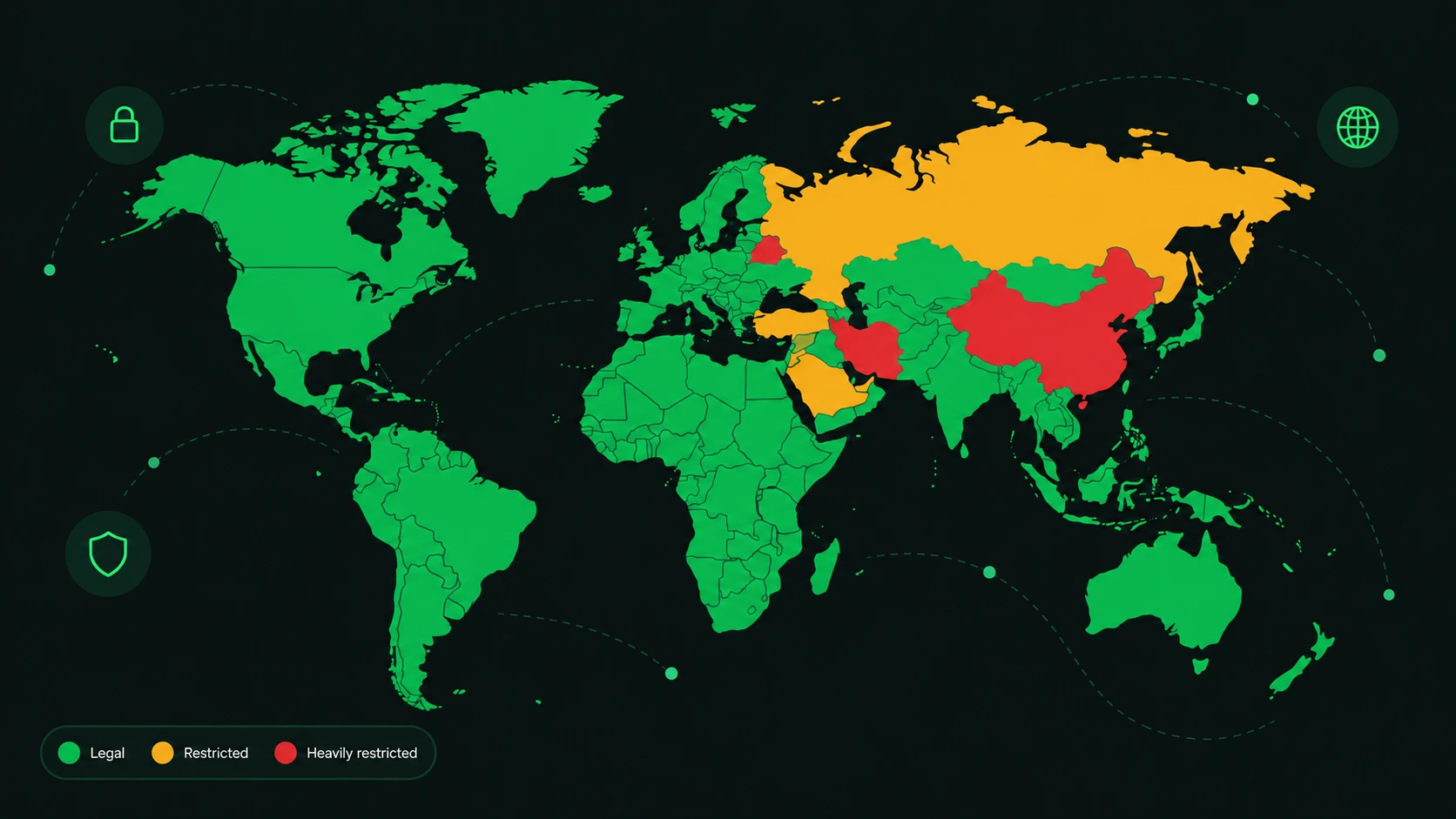
Across most of the world, ordinary consumer VPN use is legal. This includes the United States, the United Kingdom and countries throughout the European Union, where VPNs are regularly used by both individuals and organizations.
Government cybersecurity guidance reflects that normal role. The US Federal Trade Commission explains how VPN applications can protect information sent over public networks, while the UK National Cyber Security Centre provides guidance for securing connections with VPN technology. In both cases, VPNs are treated as legitimate security tools rather than inherently suspicious software.
What remains unchanged is the legality of the activity taking place through the connection. Copyright rules, computer misuse laws and other restrictions still apply after a VPN is enabled, so privacy and legality need to be considered separately.
What does a VPN actually change?
When a VPN is connected, the device establishes an encrypted connection with a VPN server. Internet traffic covered by that connection is sent through the server before reaching its final destination, which means websites generally see the VPN server's IP address instead of the public IP address assigned by the user's internet provider.
Encryption also changes what parties on the local network can observe. This is particularly useful on networks such as public Wi-Fi, where protecting traffic between the device and VPN server reduces exposure to other parties sharing the connection.
A VPN does not remove every way a website can identify someone. Logged-in accounts and browser cookies can still link activity to a user, and information entered directly into a website remains available to that website. The FTC's consumer guidance on VPN apps also points out that choosing a VPN introduces another party into the connection, which makes the provider's privacy practices important.
According to the Atomic VPN Privacy Policy, Atomic VPN does not store browsing history, traffic contents, DNS queries or network-side activity logs. Limited information needed to operate an account is handled separately from VPN traffic.
Where are VPNs legal?
Consumer VPNs can generally be used without special authorization across North America, most of Europe, Australia, New Zealand and many other regions. In these countries, installing a VPN or connecting to a server in another location does not normally create a legal issue on its own.
Regulation can still affect the companies providing those services. Privacy laws and data-retention requirements can influence what information a provider is allowed or required to keep, so two VPNs that are equally legal to use can offer very different privacy models.
The provider's jurisdiction is therefore worth considering alongside technical features. Atomic VPN is operated by AtomicMail Systems OÜ in Estonia, and its privacy documentation explains how account information and VPN network activity are handled separately.
Where are VPNs restricted?
VPN regulation becomes more complicated in countries that actively control access to the internet. The restriction may apply to particular providers, to unauthorized methods of circumventing filtering or to the online activity performed after the VPN connection is established.
Turkey is a useful example because personal VPN use is not subject to a blanket prohibition, yet individual VPN services have been blocked. Russia also allows VPN use itself while restricting numerous services and regulating certain uses of circumvention tools. China applies much broader controls to unauthorized international internet connections.
Saudi Arabia and the UAE represent a different situation. VPN technology can have legitimate uses in both countries, but local rules governing online activity remain in force when the connection passes through a VPN server.
For users, the important distinction is between legality and availability. A VPN can be legal while a particular provider is blocked, and a provider can remain technically accessible even though some activities performed through it are prohibited.
Are VPNs legal in the US?
VPNs are legal in the United States, and there is no general federal prohibition preventing consumers from installing or connecting to them. Businesses also use VPN technology extensively for remote access and network security, while consumers commonly use it to protect connections on networks they do not control.
The Federal Trade Commission gives consumers specific advice for evaluating VPN applications, including checking what information an app collects and how it protects traffic. That guidance focuses on choosing a trustworthy service rather than questioning whether the technology itself can legally be used.
US law continues to apply normally once the VPN is connected. Changing the visible IP address or encrypting traffic does not create an exception for activity that would otherwise violate federal or state law.
Are VPNs legal in the UK?
VPN use is legal in the United Kingdom, where the technology is commonly used for secure remote access and personal network protection. The National Cyber Security Centre publishes guidance specifically covering VPN infrastructure, including how organizations can route data securely across networks they do not control.
The same principle applies to consumer use. A person can generally connect to a VPN without legal difficulty, but UK law and the terms imposed by individual online services continue to apply after the connection has been established.
This distinction matters when services such as streaming platforms block known VPN addresses. A company can impose its own access rules even though VPN technology remains legal under national law.
Are VPNs legal in Europe?
Ordinary VPN use is legal throughout the European Union, where VPNs are widely used for business connectivity and personal privacy. European regulation is more likely to affect how VPN companies process customer information than whether individuals are allowed to use the underlying technology.
For users, this makes the provider's data practices an important part of choosing a service. The Atomic VPN Privacy Policy states that browsing history, DNS requests and network-side connection activity are not retained, while the account information needed to operate the service is handled separately.
This also explains why a no-log policy should not be interpreted as a claim that the provider knows absolutely nothing about a customer. A paid service may still require account and billing information even when it does not associate that information with a record of browsing activity.
Are VPNs legal in China?
China places substantially stronger controls on international internet access than the US or European countries. The country's official rules on international computer networking require international connections to use approved gateways and channels, which limits the use of unauthorized methods for reaching the wider internet.
This does not mean VPN technology has disappeared from China. Approved corporate connections and other authorized network systems can use VPN technology, so the important distinction concerns how the connection is established and whether it operates within the permitted framework.
For ordinary users, that makes China very different from countries where almost any commercial VPN can be freely installed and used. Someone planning to rely on a VPN while travelling there should check the current rules rather than assuming that a working connection is necessarily an authorized one.
Are VPNs legal in Turkey?
Turkey does not impose a blanket legal ban on personal VPN use, although access to individual VPN services has repeatedly been restricted. Freedom House reports that Turkish authorities ordered internet providers to block 17 VPN services in December 2023, while also noting that VPN services were not generally prohibited under Turkish law.
The restrictions matter because Turkey also uses website blocking and temporary platform restrictions as part of its broader internet-control system. The 2025 Freedom on the Net assessment for Turkey documents continued website blocking and social media restrictions, which helps explain why access to circumvention tools remains a recurring issue.
For an ordinary user, the result is a distinction between being allowed to use VPN technology and being able to reach a particular VPN provider. A service can become unavailable on local networks without the country introducing a general criminal prohibition on VPN use.
Are VPNs legal in Saudi Arabia?
Saudi Arabia does not impose a general blanket prohibition on VPN technology, but online activity in the country is extensively regulated. This means the legal question is usually less about whether a VPN application exists on the device and more about what is being done through the connection.
Saudi Arabia's Anti-Cyber Crime Law establishes penalties for prohibited activities carried out through computer networks, including forms of unauthorized access and other unlawful online conduct. Using a VPN does not remove those obligations because the user's connection remains subject to local law.
Internet access itself is also regulated, and some circumvention services may be unavailable from local networks. For travellers, the sensible approach is therefore to treat a VPN as a security and privacy tool rather than a mechanism that changes which Saudi laws apply.
Are VPNs legal in Russia?
Using a VPN is not itself generally prohibited in Russia, but the surrounding rules have become increasingly restrictive. During discussion of amendments adopted in 2025, the Russian State Duma stated that simply using VPN services would not itself be prohibited.
At the same time, Russia blocks numerous VPN providers and regulates tools used to bypass internet restrictions. Additional rules adopted in 2025 also addressed intentional searches for material included in the country's official list of extremist content, including situations where circumvention tools are involved.
This creates a legal environment where saying either "VPNs are legal in Russia" or "VPNs are restricted in Russia" without further explanation can be misleading. Personal VPN use itself is not generally banned, while the availability of services and some uses of circumvention technology are heavily regulated.
Are VPNs legal in the UAE?
VPN technology can legally be used for legitimate purposes in the United Arab Emirates. The country's Telecommunications and Digital Government Regulatory Authority explains that companies and institutions may use VPN connections to access internal networks.
The regulator also distinguishes those legitimate connections from services used to circumvent local internet filtering. VPN services designed to provide access around ISP restrictions can be blocked, while activities prohibited under UAE law remain prohibited when performed through a VPN.
This makes the purpose of the connection more important than the presence of the VPN application itself. Corporate remote access and the use of a VPN to reach prohibited content can fall under very different rules even though both rely on similar networking technology.
Are VPNs legal in India?
VPNs are legal for consumers in India, but the country has introduced stricter rules for certain providers. Under CERT-In's cybersecurity directions, covered VPN providers must retain specified customer information for five years or longer where another legal requirement applies.
Those requirements affect how companies operate rather than prohibiting individuals from connecting to a VPN. Several international providers have changed how they handle Indian infrastructure in response, but this should not be confused with a general consumer VPN ban.
India is therefore another example of why provider regulation and user legality need to be separated. A country can impose substantial compliance obligations on VPN companies while continuing to allow individuals to use VPN connections.
Is it illegal to use a VPN to access blocked websites?
There is no universal answer because websites can be blocked for very different reasons. A company may restrict access for licensing or account-policy reasons, while a government may order access to a website blocked under national law.
In countries where the underlying content is lawful, using a VPN may remain legal even if a private platform does not want users connecting through one. The situation changes when national legislation specifically prohibits the content or the method used to circumvent filtering.
This is especially important in countries with stronger internet controls. A VPN can make a technically blocked resource reachable, but the ability to establish the connection does not determine whether accessing that resource is legally permitted.
Is it legal to use a VPN for streaming?
Using a VPN while streaming is generally legal in countries where ordinary VPN use is permitted. The more common restriction comes from streaming platforms themselves, which can set rules covering account regions and the use of services that alter the apparent location of a connection.
A platform may detect a VPN server and refuse playback or require the user to reconnect without it. That is usually a question of the service's terms rather than evidence that VPN technology itself is illegal.
Copyright law remains separate from both issues. Changing an IP address does not grant additional rights to access, reproduce or distribute copyrighted material.
Is torrenting with a VPN legal?
Torrenting is a method of transferring files between users, and the protocol itself has many legitimate uses. Whether a particular download is legal generally depends on the material being transferred rather than whether a torrent client or VPN is involved.
A VPN can encrypt the connection used by a torrent client and replace the public IP address visible to other peers, but it does not change the copyright status of a file. Sharing copyrighted material without authorization can therefore remain unlawful even when the connection is protected.
Atomic VPN currently allows lawful P2P traffic across its server network, while users remain responsible for ensuring that the files they transfer can legally be shared or downloaded.
Can you get in trouble for using a VPN?
In countries where ordinary VPN use is unrestricted, simply connecting to one normally does not create a legal problem. Difficulties are more likely to arise when local law regulates circumvention technology, when a particular VPN provider has been blocked or when the activity performed through the service is itself prohibited.
Turkey and China show why those situations need to be separated. Turkey has blocked individual providers without imposing a blanket ban on personal VPN use, while China's rules place significantly stronger restrictions on unauthorized international connections.
Anyone travelling to a country with extensive internet filtering should therefore check current local rules. VPN restrictions can change, and an older article may no longer reflect either the legal framework or which services are technically accessible.
Can you travel with a VPN installed?
In most countries, travelling with a VPN already installed on a phone or laptop is unremarkable. The situation deserves more attention when entering a jurisdiction that restricts unauthorized circumvention or actively blocks commercial VPN providers.
Checking before departure is useful for practical reasons as well. A provider's website or authentication infrastructure may be inaccessible after arrival, which can make configuring the VPN difficult even in situations where some forms of VPN use remain permitted.
The location of the VPN server also does not replace the laws that apply where the user physically is. Connecting from Saudi Arabia to a server in Germany may give websites a German IP address, but it does not move the user into Germany for legal purposes.
Does using a VPN make you anonymous?
A VPN improves network privacy, but it does not make someone completely anonymous online. Websites normally see the VPN server's IP address rather than the public IP assigned by the user's internet provider, while encrypted traffic is protected between the device and the VPN server.
Other identifying information remains available. An account you sign into can identify you regardless of IP address, and browser cookies can continue linking visits together unless they are removed or otherwise isolated.
The provider itself also becomes part of the connection path, which is why its logging practices matter. According to the Atomic VPN Privacy Policy, the service does not keep browsing history, DNS queries, traffic contents or network-side connection records.
How to use a VPN legally
For most people, using a VPN legally follows the same principle as using a normal internet connection. The first consideration is whether the country where you are physically located places restrictions on consumer VPN services or unauthorized circumvention.
The activity performed through the connection matters just as much. Encryption and a different public IP address do not make prohibited conduct lawful, and the Atomic VPN Terms of Use similarly require the service to be used for lawful purposes.
Private network rules should also be considered separately from national law. A workplace can prohibit personal VPN applications on company hardware, while an online platform can block known VPN servers even when VPN use is completely legal in the country.
So, are VPNs legal in 2026?
VPNs remain legal for ordinary consumer use across most of the world, including the United States, the United Kingdom and the European Union. In these countries, the more important questions usually concern what the user does online and how the chosen VPN provider handles data.
A smaller group of countries requires more attention because legality, provider availability and internet filtering overlap. China imposes broad controls on unauthorized international connections, while Turkey blocks individual VPN services despite having no blanket personal VPN ban. Russia permits VPN use itself but restricts numerous services, and Saudi Arabia applies extensive online-content rules even though VPN technology is not subject to a general prohibition.
The clearest way to understand VPN law is therefore to separate the tool from the activity. A VPN can protect a connection and replace the IP address websites see, but the user's location and actions still determine which laws apply.
For users in countries where consumer VPN use is permitted, Atomic VPN provides encrypted connections through servers in more than 88 countries and operates a no-log network designed to separate account information from browsing activity.
.webp)
.png)