NordVPN is one of the most established VPN services, with a large server network, modern connection protocols and additional security tools. Its combination of privacy features and everyday usability makes it a reasonable choice for many people, although its subscription model and feature set will not suit everyone.
Some users want a cheaper VPN without committing to a multi-year promotional deal. Others need more than NordVPN's ten simultaneous device connections or prefer a service with fewer account requirements. There are also people who want a free VPN, more advanced network controls or a simpler application.
Fortunately, several NordVPN alternatives offer these advantages without giving up the essential benefits of an encrypted VPN connection. Surfshark provides unlimited device connections, Proton VPN has a free plan without data caps, and Mullvad lets users create accounts without supplying an email address. Other competitors focus on streaming, advanced configuration or straightforward pricing.
This guide compares seven of the best NordVPN alternatives in 2026, including their privacy practices, pricing, server coverage and important limitations. Each provider is evaluated according to the situations where switching from NordVPN could make sense.
Why look for an alternative to NordVPN?
NordVPN offers many features, but its strongest selling points may be unnecessary for someone who primarily wants to browse securely or change their public IP address.
One reason to consider switching is pricing. NordVPN frequently advertises discounted long-term subscriptions, but the lowest monthly equivalent usually requires paying for more than two years upfront. Its current Basic subscription is advertised at approximately $3.49 per month for the introductory 27-month period, with a total upfront payment of $94.23 before applicable taxes. The published annual renewal price is substantially higher.
This pricing model may work well for customers who already know they want a long subscription. Someone who needs a VPN for a short trip or prefers paying month to month may find a different provider more convenient.
Device limits are another consideration. Under NordVPN's connection policy, one account supports up to ten simultaneous connections. That is sufficient for many individuals, although larger households may benefit from services that allow unlimited connections.
Privacy preferences can also influence the decision. NordVPN has undergone repeated independent assessments of its no-logs practices, but some users prefer VPN providers that require less personal information during registration or offer more transparent payment models.
The best replacement depends on which of these differences matters most. Switching providers makes sense when the alternative solves a specific problem without introducing limitations that affect your everyday use.
Best NordVPN alternatives at a glance
Several providers stand out in different categories, and there is no single replacement that will be the best choice for every user.
Surfshark and Private Internet Access offer unlimited simultaneous connections. Proton VPN is especially interesting for users who want to start with a free plan, while Mullvad emphasizes minimal account information and predictable monthly pricing.
ExpressVPN provides a straightforward application experience, and CyberGhost combines streaming-focused server options with a longer refund window on eligible subscriptions. Atomic VPN is another option for users who prioritize an inexpensive annual subscription and everyday VPN connectivity.
The comparison below highlights the differences that matter most before examining each service individually.
1. Surfshark: Best NordVPN alternative for unlimited devices
Surfshark is one of the most direct competitors to NordVPN because both services offer extensive international VPN networks and additional privacy features. Their applications support modern encryption protocols, and both companies provide tools for managing how internet traffic travels through a VPN.
Surfshark's biggest advantage is its unlimited simultaneous device allowance. Under its subscription policy, customers can connect as many supported devices as they need without monitoring a fixed connection limit. This makes it an attractive choice for larger households or people who regularly use several computers and mobile devices.
Surfshark also offers Dynamic MultiHop, allowing users to customize the entry and exit locations of a multihop connection. Its Bypasser feature provides split tunneling on supported platforms, while CleanWeb blocks certain advertisements and malicious websites.
Another advantage is introductory pricing. Surfshark frequently offers long-term Starter subscriptions at a lower monthly equivalent than NordVPN Basic, although the exact rate depends on regional promotions. Customers should still check the renewal price because discounted first-term subscriptions may become more expensive later.
How does Surfshark compare with NordVPN?
Surfshark is particularly appealing when device flexibility and introductory value are the main priorities. NordVPN offers its own specialized server categories and several connection protocols, including NordWhisper for networks where conventional VPN traffic may be restricted.
There is also a corporate relationship worth understanding. Surfshark and Nord Security merged in 2022, while continuing to operate their services independently. Their applications and VPN infrastructures remain separate, so a Surfshark subscription does not provide access to NordVPN.
Surfshark is a strong alternative for families and users who want broad VPN functionality at a competitive long-term price. People who specifically need NordVPN's specialized routing options should compare those features before switching.
2. Proton VPN: Best free NordVPN alternative
Proton VPN stands out because it offers a genuinely usable free subscription alongside its paid VPN plans.
The Proton VPN Free plan has no data cap or time limit. It does not display advertisements, and the provider applies its no-logs policy to both free and paying customers. This makes it particularly attractive to users who want a VPN without immediately committing to a subscription.
The free plan supports one simultaneous device and uses a restricted selection of server locations. Server choice is also less flexible than on the paid tiers, and streaming compatibility is not guaranteed. These limitations make the free plan more suitable for ordinary browsing and occasional VPN use than for households needing several international server locations.
Proton VPN Plus removes many of these restrictions. It supports ten simultaneous connections and offers access to the company's extensive international network. Paid users also receive advanced features such as Secure Core routing and NetShield, which can block certain trackers and malicious domains.
Proton's wider ecosystem includes encrypted email and other privacy products. This can be convenient for customers who prefer to use several services from the same provider.
Is Proton VPN better than NordVPN?
Proton VPN has an obvious advantage for users who need a free VPN because NordVPN does not provide a permanent free subscription.
Both services also offer paid plans with substantial server networks and advanced security features. Proton VPN's emphasis on open-source applications and published security assessments may particularly appeal to users who value independent scrutiny of the software they install.
However, the free plan cannot be treated as equivalent to NordVPN's paid service. It supports fewer devices and provides limited location selection, which may make it unsuitable for certain activities.
Proton VPN is one of the strongest NordVPN alternatives for privacy-conscious users who want to begin with a free service and upgrade only when additional features become necessary.
3. Mullvad: Best NordVPN alternative for privacy-focused accounts
Mullvad approaches the VPN market differently from providers that compete primarily through large feature bundles and promotional pricing.
Its most distinctive feature is the account system. According to Mullvad's privacy policy, users can create an account without providing an email address, username or password. Instead, the service generates a random account number that becomes the identifier for accessing the subscription.
Mullvad also supports privacy-oriented payment methods, including cash and selected cryptocurrencies. These options can reduce the personal information shared during registration, although conventional payment methods may still involve financial records.
Pricing is unusually straightforward. Mullvad charges €5 per month, regardless of whether the customer pays for one month or prepays for a longer period. Its pricing model avoids the introductory discounts and higher renewal rates commonly associated with commercial VPN subscriptions.
The company has also concentrated its protocol development around WireGuard. Following the retirement of OpenVPN in January 2026, Mullvad's VPN infrastructure focuses on WireGuard and related privacy technologies.
Is Mullvad more private than NordVPN?
Mullvad has a clear advantage for customers who want to minimize the personal information required to create a VPN account. Its registration process is designed around a numbered identifier, while NordVPN uses a more conventional subscription account.
However, that does not automatically establish that one service provides stronger encryption or better protection against every online threat. NordVPN has undergone repeated independent no-logs assessments, and both companies publish information about their security practices.
Mullvad also has limitations. It supports five devices per account, offers a smaller server network and does not prioritize streaming compatibility in the same way as some mainstream VPN providers.
For someone who values minimal account information and a predictable monthly price, these tradeoffs may be worthwhile. Users who frequently change streaming regions or need a wider range of connection protocols may find NordVPN more convenient.
4. ExpressVPN: Best NordVPN alternative for simple everyday use
ExpressVPN is another established premium VPN provider, with applications designed to make connecting and changing server locations straightforward.
Its core VPN experience is built around the Lightway protocol, which was developed to provide efficient encrypted connections and reliable reconnection behavior. ExpressVPN also supports other protocols on compatible platforms, giving users alternatives when network conditions change.
ExpressVPN uses TrustedServer technology, a server architecture designed to reduce reliance on persistent local storage. The company has published independent assessments covering aspects of its infrastructure and privacy practices.
Another important change is its subscription structure. ExpressVPN now offers Basic, Advanced and Express Pro plans, with simultaneous device allowances of ten, twelve and fourteen respectively. These limits are documented in its official support guide.
The Basic subscription includes the core VPN service, while higher tiers provide additional privacy tools. This gives customers more flexibility in choosing a package, although it also means checking which features are included before subscribing.
ExpressVPN vs NordVPN for streaming and travel
Both providers offer extensive international networks and support streaming use cases. ExpressVPN's straightforward connection experience can be appealing to travelers who prefer an application that requires little manual configuration.
NordVPN offers additional specialized server categories, which may be more attractive to advanced users. ExpressVPN, meanwhile, provides a different balance between interface simplicity and integrated privacy features.
Streaming compatibility can change when platforms update their VPN detection systems. Neither provider can guarantee permanent access to a particular content library, so the most useful comparison involves testing the service on the devices and networks where it will be used.
ExpressVPN is a reasonable NordVPN replacement for users who prioritize accessible applications and are comfortable paying for a premium VPN subscription.
5. Private Internet Access: Best NordVPN alternative for advanced settings
Private Internet Access, commonly called PIA, is particularly interesting for users who want greater control over their VPN configuration.
Unlike many consumer VPN applications that hide most networking settings, PIA provides options for adjusting connection behavior and encryption preferences. Its supported protocols include WireGuard and OpenVPN, with additional network controls available through its applications.
PIA also supports unlimited simultaneous connections. According to its official features, one subscription can cover multiple supported devices without the ten-connection limit used by NordVPN.
One of PIA's most important differences is port forwarding. The provider allows incoming port connections through selected servers, which can be useful for applications that need to accept traffic from outside the local network.
Port forwarding is not available on every PIA server, so users should verify which locations support the feature. It is also important to understand that opening inbound connections can introduce additional security considerations depending on the application being used.
Is PIA better than NordVPN for torrenting?
PIA may be more suitable for users who rely on port forwarding or want more detailed control over VPN configuration.
NordVPN supports peer-to-peer traffic and provides specialized P2P server options, but its ordinary shared VPN service does not provide conventional user-configurable inbound port forwarding. That difference can matter for advanced peer-to-peer setups.
PIA's unlimited device allowance is another advantage, particularly when a single account is used across several computers.
However, port forwarding and customization are not essential for ordinary torrent downloads. Users who primarily want a simple connection may find either provider sufficient, depending on server performance and application preferences.
PIA is a strong NordVPN alternative for users who want advanced networking controls and are comfortable exploring additional configuration settings.
6. CyberGhost: Best NordVPN alternative for streaming-focused users
CyberGhost is a long-established VPN provider that emphasizes convenient server selection for different online activities.
Its applications include servers optimized for streaming and other supported use cases, allowing users to choose locations based on what they intend to do online. The provider supports modern VPN protocols and offers access to servers across approximately 100 countries.
CyberGhost's official website identifies support for seven simultaneous device connections. This is fewer than NordVPN's ten connections and considerably less flexible than providers offering unlimited devices.
Its pricing model, however, can be attractive for customers who are comfortable purchasing a longer subscription. CyberGhost frequently advertises discounted multi-year plans, with a lower effective monthly cost than its standard month-to-month subscription.
Another advantage is the refund window. CyberGhost offers a 45-day money-back guarantee for eligible longer subscriptions, while its monthly plan generally comes with a shorter 14-day guarantee.
That gives users additional time to evaluate the service, although the refund conditions should still be checked before purchasing.
CyberGhost vs NordVPN for streaming
CyberGhost makes streaming-related server selection particularly visible in its applications, which can be convenient for people who do not want to experiment with many ordinary server locations.
NordVPN also supports streaming through its international network and SmartPlay technology. The practical difference therefore depends on which platforms and devices the user intends to use.
Neither service can guarantee uninterrupted compatibility with every streaming platform. Restrictions can change, and a VPN server may stop working with a particular service without warning.
CyberGhost is worth considering for users who appreciate streaming-focused server categories and want a longer refund period to evaluate the connection.
7. Atomic VPN: Best NordVPN alternative for straightforward annual pricing
Atomic VPN is another option for users whose main concern with NordVPN is the cost and complexity of its subscription model.
Unlike providers that divide essential VPN functionality across several product tiers, Atomic VPN uses a straightforward subscription structure in which the chosen billing period determines the price.
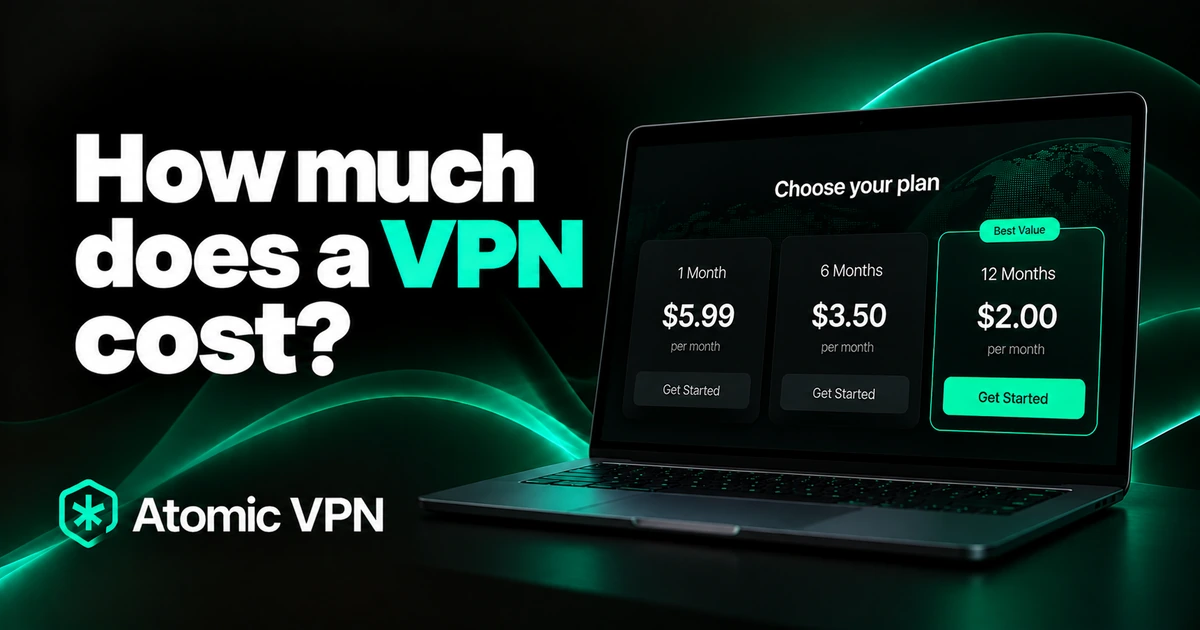
According to the Atomic VPN pricing page, its annual plan costs $2 per month, billed at $24 for twelve months. The regular monthly subscription costs $5.99, and the provider also offers a six-month option.
Atomic VPN states that its subscriptions renew at the same published rate rather than increasing after an introductory discount. This makes the longer-term cost easier to understand than promotional subscriptions that become more expensive at renewal.
Its network currently advertises more than 6,500 servers across over 88 countries, with support for WireGuard and alternative connection protocols. The service also describes its server infrastructure as RAM-only and its no-logs policy as independently audited.
One account supports five simultaneous connections. Applications are available for Windows, macOS and Android, while the iOS application is still listed as coming soon.
Some additional features, including the kill switch and split tunneling, are also marked as coming soon on the current website. Users who specifically require those protections should confirm their availability before subscribing.
Is Atomic VPN cheaper than NordVPN?
Atomic VPN currently has a lower standard annual monthly equivalent than NordVPN's advertised introductory Basic subscription. Atomic VPN charges $24 for twelve months, while NordVPN's two-year promotional plan requires a substantially larger upfront payment.
The difference is also clear for people who want to pay monthly. Atomic VPN's regular monthly rate is $5.99, compared with approximately $14.99 for NordVPN Basic under the currently advertised US pricing.
NordVPN offers more simultaneous connections and a broader collection of established security features. It also supports more operating systems through native applications, which may justify the additional cost for users who need those capabilities.
Atomic VPN is worth considering when the main priorities are straightforward billing and everyday VPN connectivity on a supported device.
Which NordVPN alternative is the cheapest?
The answer depends on whether the customer wants to pay monthly or commit to a longer subscription.
Among the services reviewed here, Proton VPN is the only provider offering a permanent free VPN plan with no data cap. It is therefore the least expensive option for users whose requirements fit within its free-tier limitations.
For paid subscriptions, Atomic VPN offers one of the lowest standard annual rates in this comparison at $2 per month, billed annually. CyberGhost and Private Internet Access also advertise inexpensive long-term subscriptions, although their promotional periods and renewal conditions differ.
Mullvad follows a different model. Its €5 monthly rate remains consistent across subscription lengths, which can make it particularly attractive for customers who want a VPN temporarily.
Surfshark and ExpressVPN frequently offer discounted introductory subscriptions. These can provide good value, but customers should calculate the total upfront payment rather than comparing promotional monthly equivalents alone.
The cheapest NordVPN replacement is therefore the service that fits the intended subscription length without requiring payment for features that will not be used.
Best NordVPN alternatives for privacy
People choosing a VPN primarily for privacy should look beyond promotional pricing and server counts.
Mullvad stands out because of its numbered account system and minimal registration requirements. This can reduce the personal information associated with a VPN subscription, particularly when combined with privacy-oriented payment methods.
Proton VPN is another strong option. Its applications are open source, and the company publishes independent security assessments. Its free plan also allows users to obtain encrypted VPN connectivity without paying for a subscription.
NordVPN itself has undergone repeated independent reviews of its no-logs practices. Several alternatives, including Surfshark and ExpressVPN, have also invested in independent verification and privacy-focused infrastructure.
These differences matter, but users should understand what a VPN can and cannot protect. A VPN hides the contents of its encrypted tunnel from the local ISP, while websites can still recognize account logins and other browser identifiers.
Choosing a privacy-focused VPN is most useful when combined with appropriate account security and careful management of personal information online.
Best NordVPN alternatives for streaming
Streaming performance depends on the relationship between the VPN provider's network and the platform being accessed.
ExpressVPN and Surfshark are reasonable options for users who want broad international coverage. Both operate extensive server networks and provide troubleshooting resources for common streaming compatibility problems.
CyberGhost also deserves consideration because its applications make streaming-focused server selection relatively straightforward.
Proton VPN Plus supports streaming on its paid servers, while its free plan does not guarantee the same level of compatibility. Mullvad has a less streaming-oriented product strategy and may be less convenient for users whose main goal is accessing specific regional content libraries.
A larger server network can provide more options when one connection encounters problems, but there is no guarantee that every location will work with every platform.
For streaming-oriented users, the most useful approach is to evaluate compatibility with the specific services and devices they regularly use before purchasing a long subscription.
Best NordVPN alternatives for unlimited devices
NordVPN supports ten simultaneous connections, which is sufficient for many individual users and smaller households.
However, people who need a VPN across numerous personal or household devices may prefer a provider without a fixed connection limit.
Surfshark and Private Internet Access both advertise unlimited simultaneous connections. This allows users to install their applications across supported devices without maintaining a strict count of active VPN sessions.
ExpressVPN is another option for customers who need slightly more than NordVPN's ten connections. Its higher subscription tiers support twelve or fourteen devices, although this requires purchasing a more expensive plan.
Atomic VPN and Mullvad each support five devices, making them better suited to individuals or smaller setups.
Unlimited device support is useful, but it does not necessarily mean that one subscription can be shared without restrictions in every possible circumstance. Customers should still review the provider's account-sharing conditions.
Best free NordVPN alternatives
Proton VPN is the clearest choice for users who want a permanent free VPN plan with meaningful privacy protections.
Its free subscription provides unlimited data and no advertising, although customers have fewer server choices and can connect only one device at a time.
Other providers occasionally offer free trials or limited promotional access, but these are different from a permanent free subscription.
A trial may require payment information and convert into a paid plan when the promotional period ends. Free plans can also have restrictions involving location selection or available features.
Users should pay attention to how a free VPN is financed. Operating VPN servers requires ongoing resources, and an unfamiliar provider offering unlimited access without explaining its business model deserves closer examination.
For most people who want a free NordVPN alternative from an established provider, Proton VPN is the most straightforward starting point.
Are cheaper VPNs as secure as NordVPN?
Price alone does not determine how secure a VPN connection is.
A lower-cost provider can use the same established encryption protocols as a more expensive competitor. WireGuard and OpenVPN are available across many VPN services, and their underlying cryptography does not become weaker simply because the subscription costs less.
Security also depends on how a provider manages its server infrastructure and applications. Independent assessments, responsible vulnerability management and transparent privacy policies offer more useful evidence than pricing alone.
Additional features can influence the practical level of protection. A functioning kill switch may matter to users who cannot risk traffic leaving the device outside a VPN tunnel, while split tunneling allows certain applications to bypass the connection intentionally.
These features should be evaluated according to the user's requirements, especially because their availability may differ between desktop and mobile applications.
A cheap VPN can therefore provide effective encrypted connectivity, although customers should verify the protections they need rather than assuming that every provider includes the same capabilities.
Are NordVPN alternatives faster?
Switching from NordVPN to another VPN does not automatically improve internet speed.
VPN performance depends on server distance, network capacity and the route between the user's ISP and the destination. Different providers may have different network partners and server locations, which can produce substantial performance differences for individual users.
Surfshark and ExpressVPN use modern protocols designed for efficient encrypted connections. Proton VPN and Private Internet Access also support WireGuard, while Mullvad has concentrated its current service around that protocol.
However, protocol support alone cannot determine which VPN will be fastest. Two providers using WireGuard may still deliver different speeds because of server congestion or network routing.
The most useful test involves comparing several nearby servers while using the same internet connection. Repeated measurements can reveal whether one provider delivers more stable throughput or lower latency under the user's actual conditions.
If the current NordVPN connection is slow, it may also be worth trying another NordVPN server or protocol before purchasing a replacement.
How to choose the best NordVPN replacement
The first step is identifying what you want to improve about NordVPN.
If the main concern is cost, compare the total amount paid during the initial subscription and the amount charged when it renews. A low promotional monthly equivalent can be misleading when it requires a long commitment.
If privacy is the priority, examine account-registration requirements and the provider's independent security assessments. Transparent data-retention policies matter more than broad promises of anonymity.
Device compatibility should also be checked carefully. A provider may support Windows and macOS while still lacking a native application for another operating system. Features such as split tunneling can also be available on one platform and unavailable on another.
Finally, consider the activities for which the VPN will be used most frequently. Streaming compatibility and advanced networking controls may be important to some users but unnecessary for someone who mainly wants to protect an everyday connection.
How to switch from NordVPN to another VPN
Switching providers is generally straightforward because consumer VPN applications manage most of the underlying network configuration automatically.
Before purchasing a replacement, check the new provider's supported operating systems and subscription terms. It is also useful to confirm whether an existing NordVPN subscription will renew automatically, since uninstalling the application does not necessarily cancel the account.
Once the replacement VPN is installed, sign in and connect to a nearby server. Verify that the public IP address changes as expected and that websites load normally through the connection.
If the new provider includes a kill switch or other network-protection options, review their availability and configuration before relying on them. Users who depend on split tunneling should also confirm that application exceptions behave as expected.
After confirming that the replacement service works, the old VPN application can be removed and its subscription canceled according to the provider's terms. Maintaining access to both services briefly can be useful when moving between providers, particularly if the new connection needs troubleshooting.
Final verdict on the best NordVPN alternatives
NordVPN remains a competitive premium VPN, but several alternatives offer meaningful advantages depending on what the customer wants to change.
Surfshark is particularly strong for households because of its unlimited simultaneous connections. Proton VPN offers the most accessible free option, while Mullvad is especially attractive to users who prefer minimal account information and simple monthly payments.
ExpressVPN provides a straightforward premium experience, and Private Internet Access offers advanced configuration capabilities that can be valuable for particular networking requirements. CyberGhost is worth considering for its streaming-oriented server selection and longer refund window on eligible plans.
Atomic VPN offers another route for users who primarily want affordable encrypted connectivity, especially through its $24 annual subscription. Its smaller device allowance and currently limited platform availability should be considered alongside the lower price.
Ultimately, the best NordVPN alternative is the service that addresses the limitations you encounter with NordVPN while maintaining the security, performance and device compatibility you need.