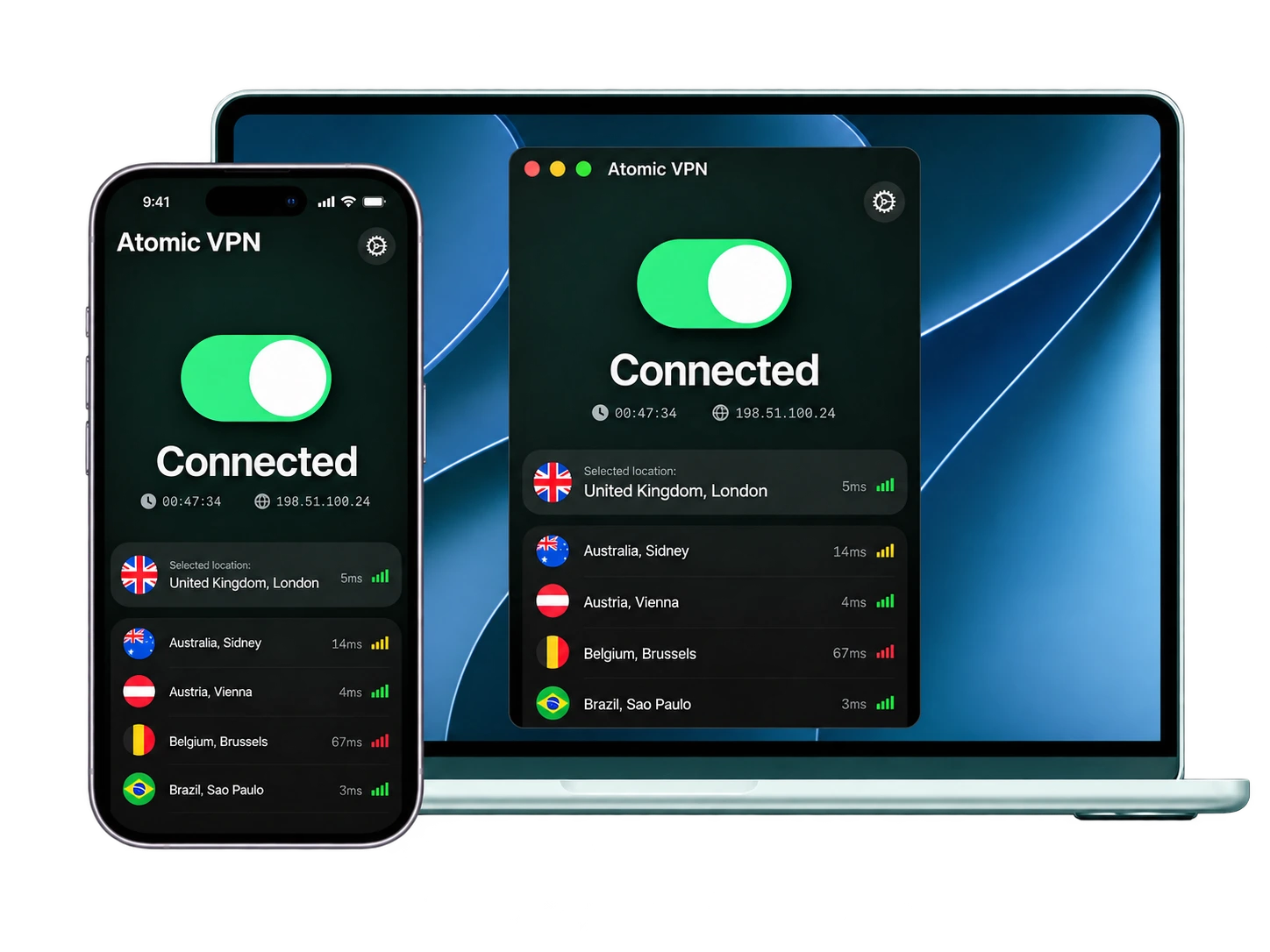
A secure VPN you can check for yourself
Audited no-logs policy, RAM-only servers and modern encryption on every plan. $1.99 a month, billed $23.99 once a year


What makes Atomic VPN secure
Security is a set of specific choices. Here are ours, with nothing rounded up
Encryption
ChaCha20-Poly1305 on WireGuard. AES-256 on OpenVPN and IKEv2
Protocols
WireGuard by default. OpenVPN and IKEv2/IPSec for networks that block it
Logs
No connection timestamps, assigned IPs, per-user bandwidth, DNS queries or browsing history
Proof
An independent third-party audit verified the no-logs policy
Servers
RAM-only, with no hard drives. A reboot wipes them clean
Leak protection
Kill switch on Windows, macOS and Android. DNS leak protection built in
Account data
An email and a payment method, stored apart from the VPN network. You can pay in BTC, XMR or USDT
Infrastructure
Hosted with an ISO 27001 certified infrastructure provider. 99.9% network uptime SLA
Company
AtomicMail Systems OÜ, based in Tallinn, Estonia
How to check if a VPN is secure in 10 minutes
Don't take a provider's word for it, ours included. You need a browser and a few minutes. Run the same checks on any VPN you're considering
Check your IP
Open an IP checker and note your address. Connect and reload. The IP and location should switch to the server you picked
Run a DNS leak test
While connected, the DNS servers in the results should belong to the VPN. If you see your internet provider, your lookups are leaking
Check WebRTC
Browsers can expose your real IP through WebRTC. A WebRTC leak test should show only the VPN address
Test the kill switch
Start a big download, then turn Wi-Fi off and on. Traffic should stop until the VPN is back, not slip out unprotected
Read the logging policy
Look for a list of what isn't stored. "We don't log your activity" on its own still leaves room for timestamps and IPs
Look for an audit
A no-logs claim checked by an outside firm is worth more than one that isn't. Check that the provider says one was done
Signs a VPN app isn't safe
Plenty of apps put "secure" in their name. These signs tell you when one isn't
You can't find the company name, address or privacy policy in two clicks
It's free forever and shows no ads. Somebody still pays for the servers
It asks for permissions a VPN doesn't need, like your contacts or SMS
The privacy policy talks about "anonymized data" instead of listing what isn't kept
It never says which protocol or encryption it uses
What a secure VPN can't protect you from
A VPN encrypts the path between your device and the server. Past that point, it isn't in charge. Knowing the limits keeps you from trusting it with the wrong job

Phishing
A fake login page steals your password just the same with a VPN on

Malware
A VPN won't clean up a device that's already infected. Encryption doesn't remove malware

Your accounts
Signed in to Google or Facebook? They still know it's you, whatever IP you use
Is a cheap VPN less secure?
Not here. The term you pick changes the price, not the protection. Every plan gets the same encryption, RAM-only servers and audited no-logs policy
The yearly plan is $1.99 a month, billed $23.99 once a year. That's $4.80 per device for the year if you use all 5. Month to month it's $5.99, still under the $10 to $15 most big VPN brands charge (approximate, prices as of October 2026)
Pick a term. Everything else is the same
Secure VPN questions
A good one is. It encrypts the traffic between your device and the VPN server. Your internet provider and anyone on the same Wi-Fi can't read it. How secure it is depends on the encryption, what it logs and whether it blocks leaks
WireGuard and OpenVPN are both considered secure when set up well. WireGuard is newer and faster, with a much smaller codebase that's easier to audit. It's the default in Atomic VPN
Some are, many aren't. Servers cost money. A free app has to earn it somewhere, often through ads or data. Check who runs it and what it logs before you install it
No. It hides your IP address and encrypts your traffic. Sites can still recognize you through accounts, cookies and browser fingerprinting
It can see that you're connected to a VPN server and how much data moves. It can't see which sites you open or what you send
In Tallinn, Estonia. The company behind it is AtomicMail Systems OÜ. You can reach support at support@atomicvpn.io
Get a secure VPN for $1.99 a month
Audited no-logs policy, RAM-only servers and 88+ countries on one account. $23.99 billed once a year. Cancel in one click