
When you press Connect in a VPN app, the application has to do much more than send your traffic through another server. Your device and the VPN server need a way to authenticate the connection, establish encryption keys, decide how network packets will travel and keep the tunnel working when network conditions change.
A VPN protocol defines how those parts of the connection work together. Different protocols can create the same basic result, an encrypted tunnel between your device and a VPN server, while taking different approaches to speed, reliability, cryptography and network compatibility.
That is why VPN apps may offer choices such as WireGuard, OpenVPN and IKEv2/IPsec even when every option connects to the same VPN service. Understanding the difference helps explain why changing the protocol can sometimes improve a slow connection, fix problems on a particular network or make switching between Wi-Fi and mobile data smoother.
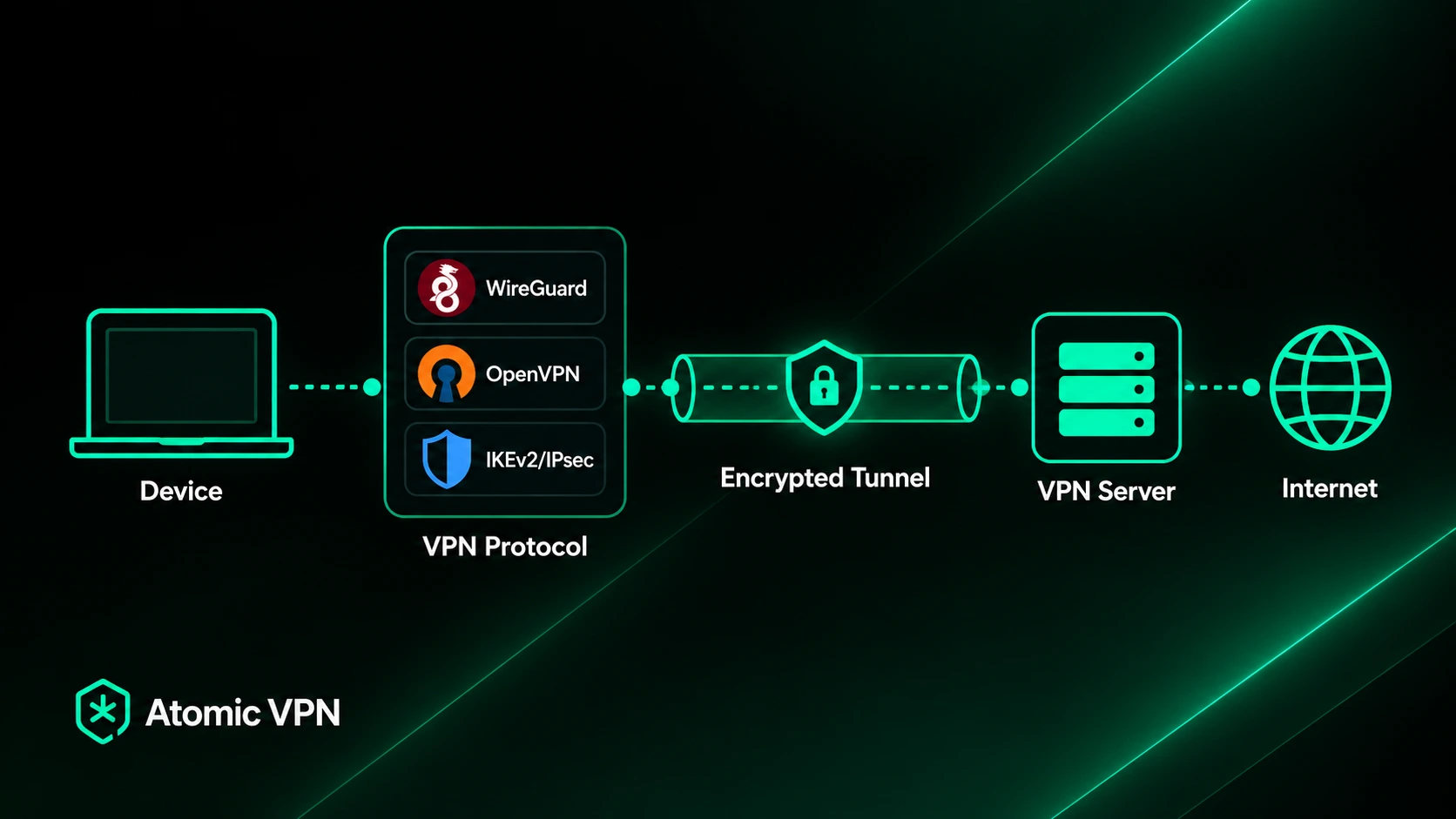
What is a VPN protocol?
A VPN protocol is a set of technical rules that determines how a VPN client communicates with a VPN server and maintains the protected connection between them. It defines important parts of the tunnel, including how the two sides authenticate, how encryption keys are established and how protected packets are transported across the internet.
The protocol is therefore broader than encryption alone. Encryption determines how information is transformed so that someone without the correct key cannot read it, while the protocol determines how that cryptography is used as part of the complete VPN connection.
An easy way to picture the relationship is to think of the encrypted tunnel as the connection itself and the VPN protocol as the instructions used to build and operate it. WireGuard, OpenVPN and IKEv2/IPsec can all protect internet traffic, but the machinery behind each tunnel is different.
What happens when a VPN protocol connects?
When a VPN connection begins, your device first needs to establish communication with the server. The exact sequence depends on the protocol, but the client and server generally authenticate the connection, establish the cryptographic material needed to protect it and then begin transporting network packets through the resulting tunnel.
Once the tunnel is active, applications can continue communicating with ordinary websites and online services. Their traffic reaches the VPN server through the protected connection, and the server forwards it toward its destination. Responses travel back through the same protected path before reaching your device.
Most of this happens within seconds, which is why a VPN application can reduce the process to a Connect button. Underneath that simple interface, the protocol continuously handles packets, encryption and the state of the connection.
VPN protocols and VPN encryption are different things
VPN protocol and VPN encryption are closely related terms, but they should not be used interchangeably. A protocol describes the larger communication system, while encryption is one of the security mechanisms that system can use.
WireGuard demonstrates the difference clearly. The WireGuard protocol uses ChaCha20-Poly1305 for authenticated encryption as part of a fixed collection of modern cryptographic primitives. ChaCha20 is an encryption algorithm; WireGuard is the protocol that defines how that algorithm and the rest of its cryptographic components are used to create the VPN connection.
OpenVPN is more configurable. The OpenVPN manual describes a broader TLS-based architecture in which the available encryption settings depend on the client, server and configuration. This flexibility is one of the reasons two OpenVPN connections do not necessarily use exactly the same cryptographic setup.
IKEv2/IPsec separates responsibilities differently again. IKEv2 negotiates and manages the secure relationship between the devices, while IPsec protects the network traffic that passes through it.
What is VPN encryption?
VPN encryption protects data travelling between your device and the VPN server. Instead of sending readable network packets across that part of the connection, the VPN transforms the protected data using a cryptographic key.
Anyone observing the connection between those two points should therefore see encrypted data rather than the original contents of the protected packets. Once the traffic reaches the VPN server, it can be decrypted and forwarded toward its destination.
This does not mean every part of the internet connection becomes encrypted by the VPN indefinitely. The VPN tunnel specifically protects the path between the device and the VPN server. HTTPS and other application-level encryption can continue protecting traffic beyond the VPN server as well.
The distinction is useful when evaluating phrases such as “encrypted VPN” or “VPN encryption.” Encryption is an essential part of modern VPN protocols, but the strength and behaviour of a VPN connection cannot be described by one cipher name alone.
What is AES-256 encryption?
AES is a symmetric encryption standard used in a wide range of security systems. The number in AES-256 refers to a 256-bit key rather than a separate VPN protocol.
The Advanced Encryption Standard published by NIST defines AES with 128-, 192- and 256-bit key sizes. VPN technologies can use AES as part of their encrypted data channel, although the exact mode matters too. AES-GCM, for example, provides authenticated encryption and is widely used in modern secure network protocols.
Seeing AES-256 in a VPN specification therefore tells you something about the encryption algorithm, but it does not tell you whether the connection is OpenVPN, IKEv2/IPsec or another protocol. WireGuard is a useful counterexample because it does not use AES for its data encryption and instead uses ChaCha20-Poly1305.
What is WireGuard?
WireGuard is a modern VPN protocol built around a deliberately compact design and a fixed set of cryptographic primitives. Instead of supporting many interchangeable cipher suites, it defines a narrower cryptographic system intended to reduce complexity.
According to the official WireGuard documentation, the protocol encapsulates IP packets over UDP and identifies peers using public keys. Its cryptographic construction uses technologies including Curve25519 for key agreement and ChaCha20-Poly1305 for authenticated encryption.
WireGuard's smaller design is important because VPN protocols can accumulate complexity over time as they support additional operating systems, algorithms and legacy configurations. WireGuard takes the opposite approach by limiting many of those choices at the protocol level.
It is also designed to handle changes to the endpoint efficiently. When a device changes networks and begins communicating from a new address, WireGuard can associate authenticated traffic with the new endpoint rather than requiring the entire VPN concept to be rebuilt around a fixed network location. That makes it particularly suitable for phones and laptops that move between different networks during the day.
What is OpenVPN?
OpenVPN is an established VPN protocol with a much more configurable architecture. It uses TLS for important parts of connection security and can carry VPN traffic using either UDP or TCP.
The ability to choose between the two transports is one of OpenVPN's most recognizable differences from WireGuard. UDP generally avoids the extra reliability mechanisms built into TCP and is commonly used when performance is the priority. TCP can behave differently on networks where UDP traffic is restricted or unreliable, although carrying TCP applications through an OpenVPN TCP tunnel can introduce additional overhead.
The OpenVPN documentation also reflects how configurable the protocol is. Server operators can control authentication, certificates and cryptographic settings rather than relying on one fixed configuration defined by the protocol.
That flexibility has helped OpenVPN remain useful across a wide range of systems and networks. At the same time, it makes the phrase “OpenVPN connection” less specific than it may initially appear because the exact configuration can differ between providers.
What is IKEv2?
IKEv2 stands for Internet Key Exchange version 2. Its role is primarily to establish and manage the security associations used by IPsec rather than carry ordinary application traffic as a standalone encrypted tunnel.
The IKEv2 standard in RFC 7296 defines how two peers authenticate and establish the cryptographic information needed for their protected connection. Once those security associations exist, IPsec can use them to protect IP traffic.
IKEv2 also works with extensions designed for mobile connections. The MOBIKE standard, for example, allows an IKEv2 security association to survive changes to IP addresses and network interfaces. This is useful when a phone moves between Wi-Fi and cellular data without the user wanting to manually reconnect the VPN each time.
For this reason, IKEv2/IPsec remains a common choice on mobile devices even though newer protocols such as WireGuard have become widely available.
What is an IPsec VPN?
IPsec is a family of standards designed to protect traffic at the IP layer. Instead of being a single consumer VPN application or one simple handshake protocol, IPsec defines mechanisms that can authenticate and protect IP packets between network endpoints.
The IPsec architecture described in RFC 4301 defines the broader framework, while components such as Encapsulating Security Payload provide protection for the data being transmitted. In consumer VPN applications, IPsec is commonly paired with IKEv2, which handles the negotiation and management required to establish the secure connection.
That is why VPN applications frequently show one option called IKEv2/IPsec. IKEv2 and IPsec perform different jobs, but together they form the complete VPN connection presented to the user.
The phrase “IPsec VPN” can also appear in business networking, where IPsec is used to connect entire networks or offices rather than an individual consumer device. The underlying standards are related, even though the deployment can look very different from a VPN app running on a phone.
WireGuard vs OpenVPN
WireGuard and OpenVPN can both create secure VPN tunnels, but they come from different design philosophies. WireGuard limits many configuration choices and uses one modern cryptographic construction, while OpenVPN gives administrators far more control over transport and cryptographic configuration.
That difference can affect performance. WireGuard has less protocol complexity and a relatively small implementation, while OpenVPN carries more historical and configuration overhead. In many environments this can allow WireGuard to deliver lower latency or higher throughput, although the result still depends heavily on the VPN server, network path and device.
OpenVPN has an advantage when flexibility is more important. Its ability to operate over UDP or TCP gives VPN providers options for networks where one type of transport performs poorly or is unavailable.
This is why a useful WireGuard vs OpenVPN comparison should not stop at a simple speed test. The faster option on one connection may not be the more reliable one on another network, and protocol performance can vary significantly with server location and congestion.
WireGuard vs IKEv2/IPsec
WireGuard and IKEv2/IPsec are both well suited to devices that regularly move between networks, but they achieve that through different architectures. WireGuard keeps its protocol comparatively compact, while IKEv2 is part of the larger IPsec ecosystem and can use mechanisms such as MOBIKE to maintain connections when the device's network address changes.
On modern VPN services, either can provide a fast and stable connection. Differences become more noticeable when particular operating systems or networks handle one protocol better than another.
The choice therefore does not need to be permanent. A VPN application can offer several protocols precisely because no single networking environment behaves the same way everywhere.
OpenVPN vs IKEv2/IPsec
OpenVPN and IKEv2/IPsec are both mature options, but they differ substantially in how they establish and transport VPN traffic. OpenVPN uses its own VPN architecture built around TLS and can operate over UDP or TCP, while IKEv2 manages an IPsec connection at the network layer.
IKEv2/IPsec can be particularly attractive on mobile systems because it integrates well with native IPsec support and can recover from network changes efficiently. OpenVPN provides more transport flexibility, which can make it useful when compatibility with a particular network matters more than choosing the newest protocol.
Neither label by itself guarantees better performance. Implementation quality, server load and the route between the client and VPN server can have as much influence on the experience as the protocol name.
Which VPN protocol is the fastest?
There is no protocol that will be fastest on every network. WireGuard is often capable of strong performance because of its relatively streamlined design, but protocol choice is only one part of VPN speed.
The physical distance to the VPN server, available server capacity and the quality of the user's original internet connection can all have a larger effect. A nearby OpenVPN server may outperform a congested WireGuard server on another continent even though WireGuard itself has less protocol overhead.
The same applies when comparing UDP and TCP. A configuration that performs well on a normal home connection may behave differently on a restrictive corporate or public network.
For useful speed comparisons, protocols should therefore be tested against the same server location and under similar network conditions rather than compared using isolated headline numbers.
Which VPN protocol is the most secure?
Modern implementations of WireGuard, OpenVPN and IKEv2/IPsec can all provide strong cryptographic protection when configured correctly. Their differences are more meaningful in architecture, implementation and configuration than in a simple “secure versus insecure” ranking.
WireGuard reduces the number of cryptographic choices by defining a fixed modern suite. OpenVPN supports more configuration options, while IKEv2/IPsec relies on negotiated IPsec security associations. Each approach has advantages, but all three are established technologies used for secure VPN connections.
The provider still matters. A technically strong protocol cannot compensate for poor key management, insecure infrastructure or inappropriate logging practices elsewhere in the service.
This is why choosing a VPN based only on an encryption label such as AES-256 can be misleading. The protocol, implementation and provider infrastructure all contribute to the security of the connection.
What about PPTP and L2TP/IPsec?
Older VPN protocols still appear in guides and operating-system settings, but they are less relevant to modern consumer VPN services. PPTP is particularly old and relies on security mechanisms that are no longer considered suitable for a modern privacy service.
L2TP is different because it is primarily a tunnelling protocol and has traditionally been paired with IPsec for encryption. L2TP/IPsec can still appear on older devices and enterprise systems, but modern VPN applications increasingly favour protocols such as WireGuard, OpenVPN and IKEv2/IPsec.
Supporting fewer legacy protocols is not necessarily a disadvantage. Removing outdated options can reduce configuration complexity while keeping the VPN focused on protocols that match current security and performance expectations.
Why does changing the VPN protocol sometimes fix a connection?
Two VPN protocols can behave differently even when they connect to the same server location. They may use different packet formats, transports and operating-system networking components, which means a network problem affecting one protocol may not affect another in the same way.
OpenVPN illustrates this especially clearly because UDP and TCP connections can behave differently on the same network. WireGuard uses UDP, while IKEv2/IPsec relies on its own standardized network exchanges. Firewalls, routers and network address translation can therefore interact with each option differently.
Switching protocols is consequently a useful troubleshooting step when a VPN connects poorly or becomes unstable. It does not mean one protocol is permanently better; it means changing the protocol changes the way the VPN connection interacts with that particular network.
Which VPN protocol should you use?
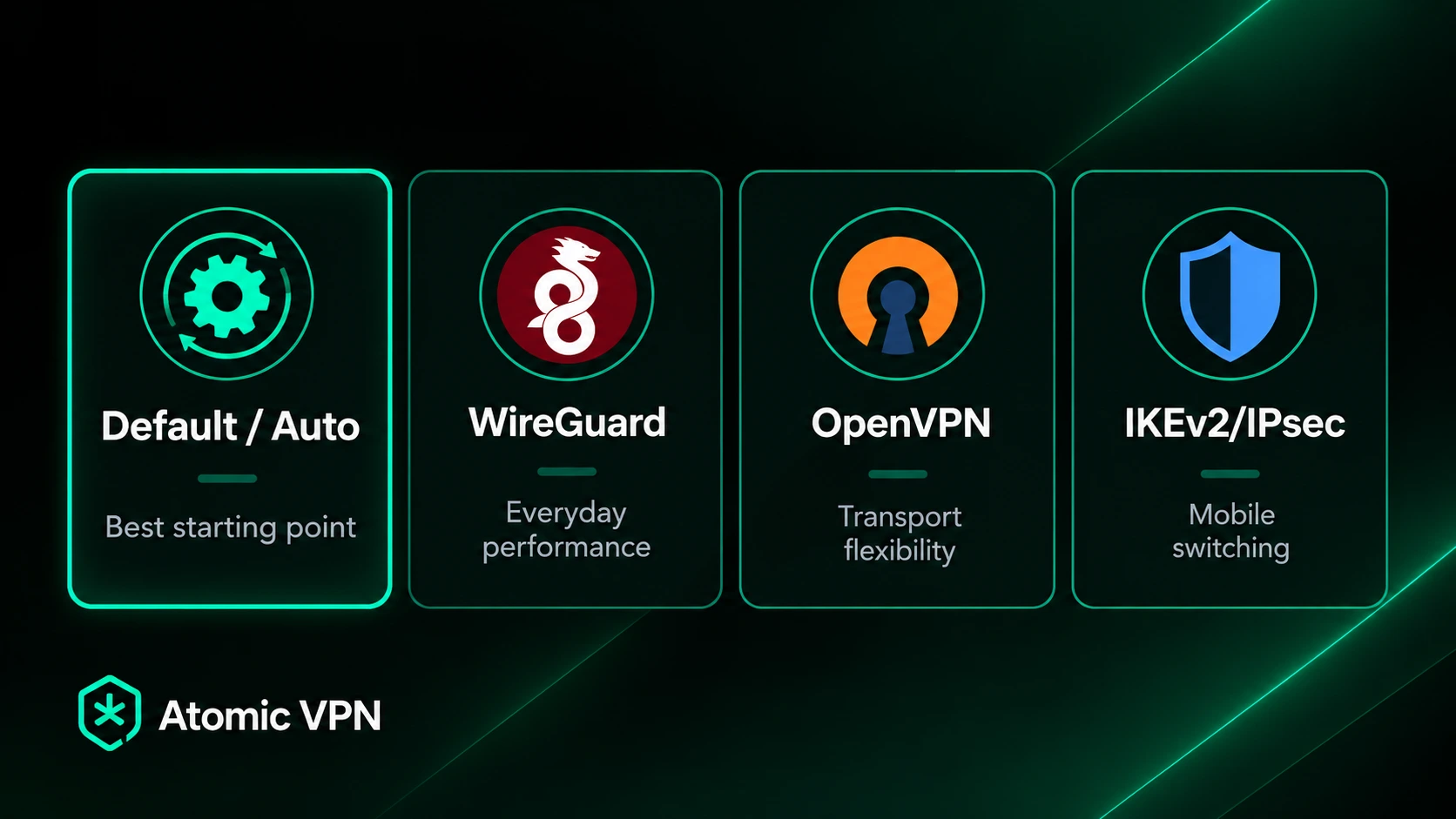
For most users, the best starting point is the protocol recommended automatically by the VPN application. A well-designed automatic mode can select an appropriate protocol without requiring the user to understand the networking differences behind each option.
WireGuard is a strong general-purpose choice when performance and a modern streamlined protocol are priorities. OpenVPN remains useful when its configurable transport options work better on a particular network, while IKEv2/IPsec can provide a stable option for devices that frequently change connections.
Atomic VPN supports WireGuard, OpenVPN and IKEv2/IPsec, so switching between these approaches does not require changing VPN providers or server locations. If the default connection works well, there is usually little reason to change it manually. Protocol selection becomes most useful when troubleshooting a particular network or comparing performance under the same conditions.
Why VPN protocols matter
The protocol is one of the pieces that determines what happens between pressing Connect and seeing the VPN become active. It controls how the tunnel is established, how protected packets move and how the connection reacts when network conditions change.
That makes protocol choice important, but it should not be treated in isolation. Server infrastructure, distance and network conditions also affect performance, while privacy depends on the VPN provider's broader technical and data-handling practices.
For most people, the practical benefit of having several modern VPN protocols is flexibility. You can use the default when it works well and switch to another option when a particular network, device or use case calls for a different approach.
.webp)
.png)