
A proxy and a VPN can produce the same visible result. You connect through another server, websites see that server's IP address instead of your usual one, and your apparent location can change. That similarity is why the two are often treated as interchangeable, even though they solve different problems.
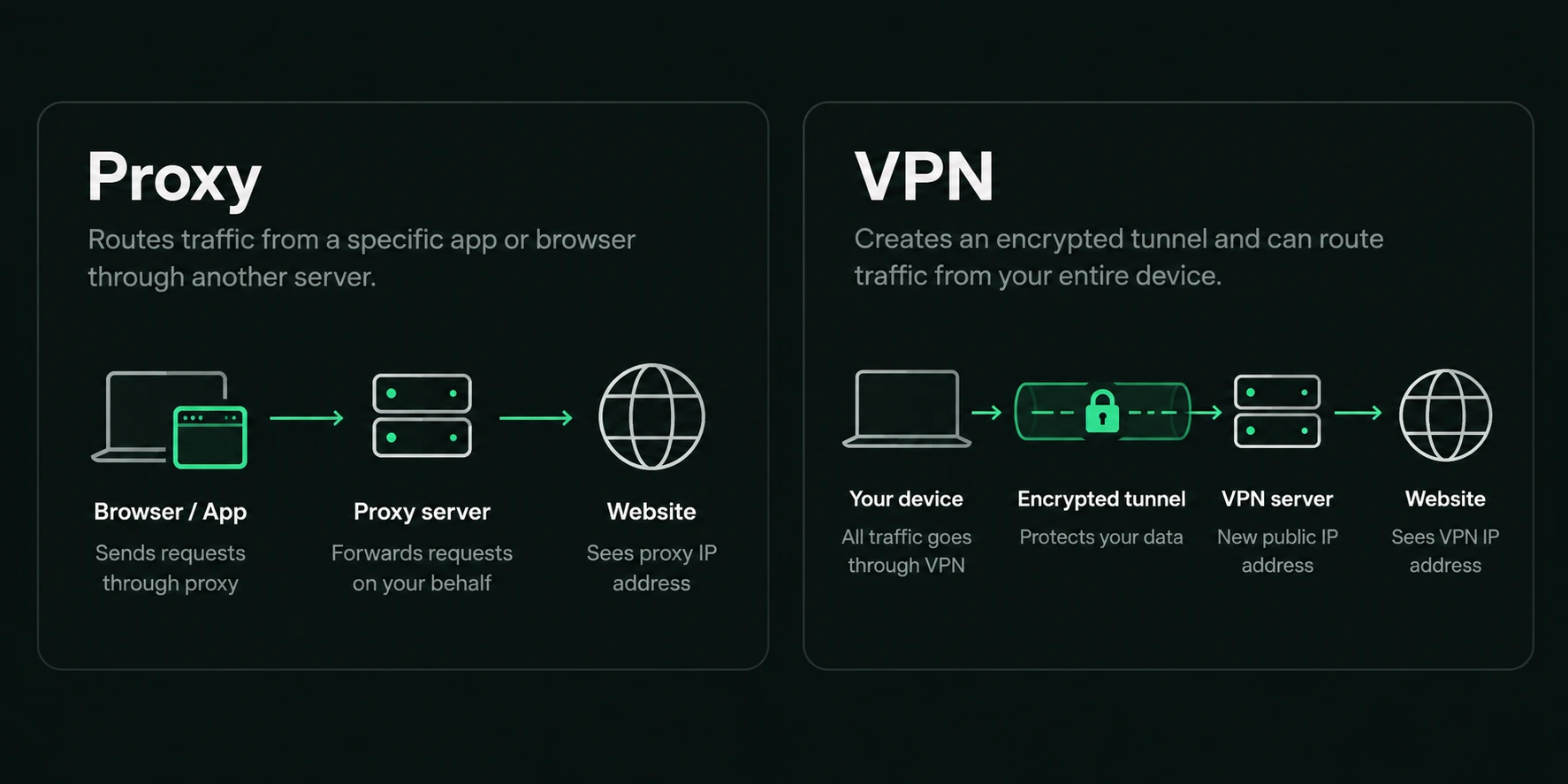
The difference is easier to understand when you look at what happens to the connection itself. A proxy usually forwards traffic from a specific browser or application, while a VPN creates an encrypted connection between your device and a VPN server and can route traffic from multiple applications through it.
That difference affects privacy, security and convenience. A proxy can be useful when you only need to reroute one application, while a VPN is usually better suited to protecting a broader internet connection.
What is a proxy?
A proxy server works as an intermediary between an application and the destination it wants to reach. Instead of sending a request directly to a website, the application sends it to the proxy, which then forwards the request and returns the response.
Because the website communicates with the proxy, it normally sees the proxy server's IP address rather than the user's original public IP. Cloudflare describes a forward proxy as a server that sits in front of clients and sends requests on their behalf, which is the basic model behind most consumer proxy use.
The important limitation is that a proxy often works only where it has been configured. If you add a proxy to a browser, traffic from that browser may pass through the proxy while a game, messaging app or cloud client continues using the normal internet connection.
This limited scope is useful when that is exactly what you want. It also means that changing the IP address in one application should not be confused with protecting the entire device.
What is a VPN?
A VPN also sends traffic through another server, but it usually operates at a broader level. Once connected, the VPN creates an encrypted tunnel between the device and the VPN server, and traffic covered by that connection travels through the tunnel before reaching the wider internet.
Cloudflare explains VPNs as services that create encrypted connections over the internet, which is the main technical difference from an ordinary proxy. The VPN is designed around protecting the connection between the device and the VPN server rather than simply forwarding requests.
Consumer VPN applications usually handle this at the operating-system level. That allows traffic from browsers and other applications to use the same connection without configuring each program separately.
Atomic VPN follows this model and supports WireGuard, OpenVPN and IKEv2/IPsec across its network. Instead of changing the connection for one browser tab, it is designed to protect supported traffic across the device.
Proxy vs VPN at a glance
The clearest distinction is not whether either tool can change your IP address, because both can. The more useful question is how much traffic they cover and whether the connection between your device and the intermediary is encrypted.
A typical proxy is more selective. It can be configured for a particular browser or application and leaves other traffic alone. A VPN is usually broader and can protect several applications through the same encrypted connection.
There are exceptions on both sides. System-wide proxies exist, and VPNs can use split tunneling to exclude selected applications, but those are configuration choices rather than the way most consumer setups work by default.
The biggest difference is encryption
Changing an IP address and encrypting a connection are separate functions. A proxy can provide the first without necessarily providing the second.
If a browser sends HTTPS traffic through a proxy, the connection to the website can still be encrypted by HTTPS. That does not automatically mean the connection between the device and the proxy has the same protection as a VPN tunnel.
A VPN is built around that encrypted link. The US Federal Trade Commission explains that VPN applications can encrypt traffic between a device and the VPN provider's server, which is especially relevant when the local network cannot be trusted.
This is why the difference matters on public Wi-Fi. A proxy can change the route of selected traffic, while a VPN is designed to protect the connection leaving the device before it reaches the VPN server.
Does a proxy hide your IP address?
A proxy normally hides the original public IP address from destinations reached through it. The website sees the proxy server as the source of the request, which is the same visible effect users often associate with a VPN.
The limitation is that only proxied traffic receives that new IP address. If another application is not using the proxy, it can continue connecting directly and expose the device's normal public IP.
That makes a proxy useful for controlled routing, but it should not be treated as automatic device-wide privacy. The result depends on which applications have actually been configured to use it.
Does a VPN hide your IP address?
A VPN also replaces the public IP address visible to websites for traffic routed through the VPN server. The difference is that a typical VPN client handles this across a much larger portion of the device's internet activity.
Changing the IP address does not make someone anonymous. Websites can still identify logged-in accounts and recognize browser cookies, while information submitted directly to a service remains available regardless of which server the connection passes through.
The Atomic VPN website demonstrates several pieces of information a website can normally detect from a visit, including IP address, approximate location and internet provider. A VPN changes some of those network-level signals, but it does not erase account or browser-level identity.
Does a proxy encrypt your traffic?
A proxy does not automatically encrypt traffic simply because it forwards it. The level of protection depends on the proxy protocol and how the application connects to it.
HTTP proxies are mainly designed to relay web requests, while SOCKS proxies can handle a wider range of traffic. SOCKS5 is especially flexible, although encryption is not a built-in guarantee of the protocol itself. The SOCKS5 specification in RFC 1928 defines how connections can be relayed and supports separate authentication methods rather than requiring a universal encrypted tunnel.
This is one of the easiest places to misunderstand the difference between a proxy and a VPN. A different IP address proves that traffic was routed through another server, but it does not prove that the route to that server was encrypted.
What types of proxies are there?
The most common consumer proxy types are HTTP, HTTPS and SOCKS proxies, and each is designed for a slightly different kind of traffic. HTTP proxies are closely associated with web requests, while SOCKS operates at a lower level and can work with a wider range of applications.
SOCKS5 also supports both TCP connections and UDP associations according to RFC 1928, which is why some applications use it for traffic that does not fit neatly into a browser-only setup.
Other proxy categories exist for completely different purposes. Reverse proxies, for example, normally sit in front of websites and servers rather than in front of the user, so they are part of web infrastructure and should not be confused with a consumer proxy alternative to a VPN.
Which protects more of your device?
For a typical consumer setup, a VPN covers more traffic because it operates below the level of a single browser or application. Once the VPN connection is active, multiple supported applications can use the same encrypted tunnel.
A browser proxy behaves differently because the configuration can remain limited to that browser. Opening a website may use the proxy IP, while another application continues connecting through the regular network without any change.
Mozilla's comparison of VPNs and web proxies makes the same distinction by describing a web proxy as browser-focused while a VPN can protect traffic more broadly across the device.
This broader scope is one of the main reasons VPNs are usually chosen for privacy and network security rather than for a single routing task.
Proxy vs VPN for public Wi-Fi
Public Wi-Fi is a situation where the difference between routing and encryption becomes more important. The goal is usually to protect the connection from the local network rather than simply make a website see another IP address.
A VPN is better suited to that task because the encrypted tunnel begins on the device and continues to the VPN server. Someone operating or monitoring the Wi-Fi network can still see that the device is communicating, but protected traffic inside the tunnel is much harder to inspect directly.
A proxy configured only in a browser does not automatically cover traffic from other applications, and the connection to the proxy may not provide equivalent encryption. The FTC recommends checking how a VPN protects traffic and what information the provider collects, because the VPN company becomes part of the trust relationship once the connection is established.
Proxy vs VPN for changing your location
Both a proxy and a VPN can change the location associated with an IP address. If the server is in Germany, a website may treat the connection as German regardless of whether the traffic arrived through a proxy or VPN.
The practical difference is again the scope of the connection. A proxy configured inside one application can change the apparent location only for that application, while a device-level VPN can give multiple applications the same server location.
IP location is also only one signal. Apps can use device location permissions, account settings and stored browser data, so connecting through another country does not guarantee that every service will treat the user as physically located there.
Proxy vs VPN for streaming
A proxy can work for streaming when the streaming service runs inside the same browser or application that has been configured to use it. The setup becomes less convenient when several applications or devices need to use the same routed connection.
VPNs are usually easier in that situation because the connection can operate at device or router level. A streaming app does not need its own proxy settings if its traffic is already passing through the VPN tunnel.
Neither option guarantees access to a particular streaming library. Platforms can detect and block traffic from known proxy or VPN servers, and their terms can restrict how location-changing tools are used even where the underlying technology is legal.
Proxy vs VPN for torrenting
Torrenting makes the difference in application coverage especially clear. A proxy configured only inside a browser has no effect on a separate torrent client, so the torrent application would need its own proxy configuration.
Some torrent clients support SOCKS5 directly, which allows peer-to-peer traffic to be routed through the proxy. That should still not be confused with the encrypted tunnel created by a VPN because SOCKS5 itself does not automatically provide equivalent encryption.
A VPN can route the torrent client's traffic through the same protected connection used by other applications. Atomic VPN allows lawful P2P traffic across its network, although using a VPN does not change the copyright status of any file being transferred.
Which is faster, a proxy or a VPN?
A proxy can sometimes introduce less processing overhead because it may forward traffic without encrypting an entire device-level connection. In practice, that does not mean proxies are automatically faster.
Server distance and load can have a larger effect than the technology category itself. A congested proxy far from the user can perform worse than a nearby VPN server with a fast connection.
Modern VPN protocols have also reduced the performance gap considerably. Atomic VPN supports WireGuard as well as OpenVPN and IKEv2/IPsec, allowing the connection to use different protocols depending on the platform and network conditions.
For real-world performance, testing the actual server and connection is more useful than assuming that a proxy must be faster because it does less.
Are free proxies safe?
Free proxies vary widely in quality, and the main issue is trust. The proxy operator sits in the path of traffic that has been deliberately routed through its infrastructure, which means its logging and security practices matter.
A free service may record connection information or operate without clearly explaining what data it keeps. The risk increases when the provider is difficult to identify or offers no meaningful privacy documentation.
The same principle applies to VPNs. The FTC warns that VPN providers can potentially access sensitive network information, so a paid VPN should not be trusted automatically either.
The important question is who operates the service and what happens to the data passing through it.
Privacy depends on the provider
A VPN can protect traffic from the local network and ISP, but the connection still has to pass through the VPN provider's infrastructure. This shifts part of the trust from one party to another rather than removing trust from the system entirely.
Logging policies therefore matter. A provider that stores source IP addresses, connection times and activity records creates a different privacy model from one that avoids retaining network-side activity.
According to the Atomic VPN Privacy Policy, Atomic VPN does not store browsing history, DNS queries, traffic contents, originating IP addresses or assigned VPN IP addresses as network activity logs. Account and subscription information is maintained separately from browsing activity.
The Atomic VPN Terms of Use also make clear that a VPN protects the connection but does not create complete anonymity or replace the other security practices a user may need.
Can you use a proxy and a VPN together?
A proxy and a VPN can technically be used at the same time. An application can send traffic through a proxy while the operating system is already connected to a VPN, which can create a route that passes through both services.
That setup introduces more complexity and another intermediary into the connection. It can also increase latency and make connection problems harder to diagnose.
For most consumer use cases, combining the two does not provide enough benefit to justify the additional configuration. It usually makes more sense to choose the tool that matches the actual task and keep the connection path simpler.
When does a proxy make more sense?
A proxy is useful when the goal is limited and application-specific. If one browser or automation tool needs to send traffic through another IP address while everything else should stay on the normal connection, that selective behavior can be useful.
It can also make sense when an application already supports a particular proxy protocol and device-wide encryption is not part of the requirement. In that situation, using a VPN may add broader routing than the task actually needs.
The key advantage of the proxy is therefore control over a narrow part of the connection rather than broader privacy.
When does a VPN make more sense?
A VPN is usually the better fit when the goal is to protect a larger part of the device's internet traffic. Public Wi-Fi and general browsing privacy are common examples because both benefit from an encrypted connection that begins at the device.
It is also easier when several applications should use the same server without being configured individually. Once the VPN connection is active, supported traffic can be routed through the tunnel as part of the same setup.
This makes VPNs more appropriate when privacy and connection security are the main objective, while proxies remain useful for narrower routing tasks.
Proxy or VPN. Which should you use?
The choice depends on what you want to change about the connection. If the goal is to route one browser or application through another IP address while leaving the rest of the device alone, a proxy can be the simpler tool.
A VPN makes more sense when you want the connection itself protected and several applications covered by the same setup. The encrypted tunnel is the important difference because it adds protection between the device and the VPN server rather than simply changing which server forwards a request.
Both technologies can hide the original IP address from destinations reached through them, so that feature alone does not separate them. The more useful distinction is whether you need selective routing or broader encrypted protection.
If the second option matches what you need, Atomic VPN provides device-level encrypted connections across a network spanning more than 88 countries, with the provider's logging practices described separately in its Privacy Policy.
.webp)
.png)